


Walk into almost any neighborhood Thai restaurant around the world, and you will likely see a framed portrait of a Thai royal hanging respectfully near the entrance, right beside the golden statues and fragrant plates of pad thai and green curry. Food is usually the first doorway foreigners walk through when they fall in love with Thailand. You taste that bright balance of sweet, sour, salty, and spicy, and suddenly you want to understand the people, the manners, and the pride behind the cooking.
Yet for millions of people in the West, their very first mental picture of Thai royalty came from a Broadway stage and a 1956 Hollywood movie musical called The King and I. Pull back the curtain on that famous musical, and you find two completely different worlds colliding. On one side of the stage stands the fictional king made famous by actor Yul Brynner: a bare-chested, stubborn, semi-barbaric ruler who pounds his fists, barks “Etcetera, etcetera, etcetera,” and needs a proper British schoolteacher to teach him basic manners and how to polka. On the other side of history stands the real man: King Mongkut, also known as Rama IV, sitting in a quiet Bangkok observatory surrounded by brass telescopes, English dictionaries, a printing press, and letters from Queen Victoria and Abraham Lincoln.


Looking closely at the gap between those two kings reveals how Thailand pulled off one of the greatest diplomatic survival acts in world history, and how 1950s American laws and Hollywood prejudices created a caricature that still stings in Thailand today.
The Broadway Illusion vs. The Scholar-King
The whole rumor mill started with Anna Leonowens. In 1862, King Mongkut hired Anna to teach English and modern science to his children and wives inside the Grand Palace. In his hiring letter, his instructions were straightforward: teach them English, science, and literature, and leave Christian missionary work out of the classroom. He was hiring a specialized tutor to give his kids modern skills.
Anna stayed in Bangkok for less than six years. Once she returned to the West and needed money, she published two heavily sensationalized memoirs, The English Governess at the Siamese Court and The Romance of the Harem. Historians have since uncovered that Anna invented much of her own biography. She claimed to be a highborn Welsh lady whose husband was a British army officer killed in India. In reality, she was born in India to a working-class family of mixed British and Indian heritage, and her husband was a low-ranking army clerk who died of a stroke in Malaysia.
If Anna could rewrite her own family tree to impress Victorian readers, rewriting the King of Siam was easy. Decades later, American writer Margaret Landon turned Anna’s exaggerated books into a 1944 novel, and Richard Rodgers and Oscar Hammerstein II turned that novel into the 1951 Broadway hit The King and I. With every new adaptation, the real King Mongkut disappeared a little further. In the musical, the King struggles to grasp basic Western ideas, stares in shock at a world map, and relies on Anna to whisper advice in his ear so he avoids embarrassing himself in front of European diplomats.
In reality, King Mongkut was one of the most educated thinkers in nineteenth-century Asia. Before taking the throne at age 46 in 1851, Mongkut spent 27 years living as a Buddhist monk. He walked barefoot every morning on alms rounds for his daily food, gave up royal luxury, and traveled across the countryside talking directly with ordinary farmers, fishermen, and merchants. During nearly three decades in saffron robes, he studied Buddhist scriptures alongside learning Latin from a French bishop, practicing English with American missionaries, mastering advanced mathematics, and devouring books on Western astronomy, physics, and world politics.
When his half-brother died and Mongkut ascended the throne, he moved fast to modernize the kingdom. He opened Siam to global trade, set up the country’s first modern printing press to publish official government gazettes, reformed the Buddhist sangha to strip away superstition, and pushed for stronger legal protections for women and children. Even the famous musical scene where Anna demands that her head never sit lower than the King’s completely twists local custom. In traditional Thai etiquette, keeping one’s head lower than a monarch’s was a standard gesture of physical respect, much like kneeling or bowing in European royal courts. Ironically, King Mongkut was the very ruler who began relaxing ancient royal taboos, allowing everyday citizens to look directly at him during public processions for the first time.
Playing Chess Against Colonial Empires
Map out Southeast Asia in the 1850s and 1860s, and it becomes obvious why Thai people hold King Mongkut in such deep reverence. Siam, as Thailand was then called, sat wedged right between two hungry European empires.
To the west, Britain was swallowing up Burma and Malaya. To the east, France was carving up Vietnam, Cambodia, and Laos. Both superpowers had warships cruising nearby, and both eyed Siam’s rich rice plains, teak forests, and strategic trade routes. Every single neighboring kingdom around Siam eventually fell under European rule.
King Mongkut knew Siam could never defeat British or French gunboats in a shooting war, so he beat them at the negotiating table instead. European empires routinely justified invading Asian kingdoms by claiming local rulers were “uncivilized,” chaotic, and hostile to free trade. Mongkut took away their favorite excuse.
In 1855, he welcomed British envoy Sir John Bowring to Bangkok and signed the Bowring Treaty. While the agreement forced Siam to give up certain tax revenues and legal jurisdiction, it gave Britain enough commercial access that London realized invading Siam would cost far more money and trouble than simply trading with the King. Mongkut quickly signed similar treaties with France, the United States, and other Western powers, balancing their competing ambitions against each other. Whenever France pushed too hard on Siam’s eastern border, Mongkut leaned closer to Britain; whenever Britain made heavy demands, he smiled at the Americans and French.
He even proved his intellectual standing on the world stage through pure science. In 1868, King Mongkut calculated the exact time and path of a total solar eclipse, predicting it would pass directly over a remote coastal village called Wakor in southern Siam. His math was so accurate that he beat the calculations of professional French astronomers by two seconds. He invited French scientists, British officials, and the Governor of Singapore to camp out in the jungle with him to watch the sky go dark right on schedule. Tragically, mosquitoes in that jungle camp infected the King with malaria, and he died six weeks later at age 63. His scientific triumph cost him his life, yet it proved to European powers that Siam was led by a world-class modern scholar.
1950s America and the Invention of the “Yellowface” Caricature
Why did Rodgers and Hammerstein’s version of King Mongkut become such an instant smash in 1951 and 1956? Look at what was happening inside the United States at that exact moment.
When The King and I opened on Broadway in 1951, Asian Americans, and Asian men in particular, were just beginning to emerge from nearly a century of explicit legal discrimination passed by Congress. Starting with the Page Act of 1875 and the Chinese Exclusion Act of 1882, federal laws barred Chinese laborers from entering the country, banned them from becoming naturalized citizens, and kept them from bringing wives to America. For decades, anti-miscegenation laws across dozens of states made it illegal for Asian men to marry white women, while local ordinances pushed Asian men out of mainstream careers into isolated bachelor communities, laundries, and restaurants. Even after Congress repealed the Chinese Exclusion Act in 1943 during World War II, strict racial quotas stayed on the books until the McCarran-Walter Act of 1952, and the cultural habits were already baked into American show business. Meanwhile, in the early 1950s, the United States was locked in the Korean War and the Cold War, viewing Asia through a lens of suspicion and paternalism.


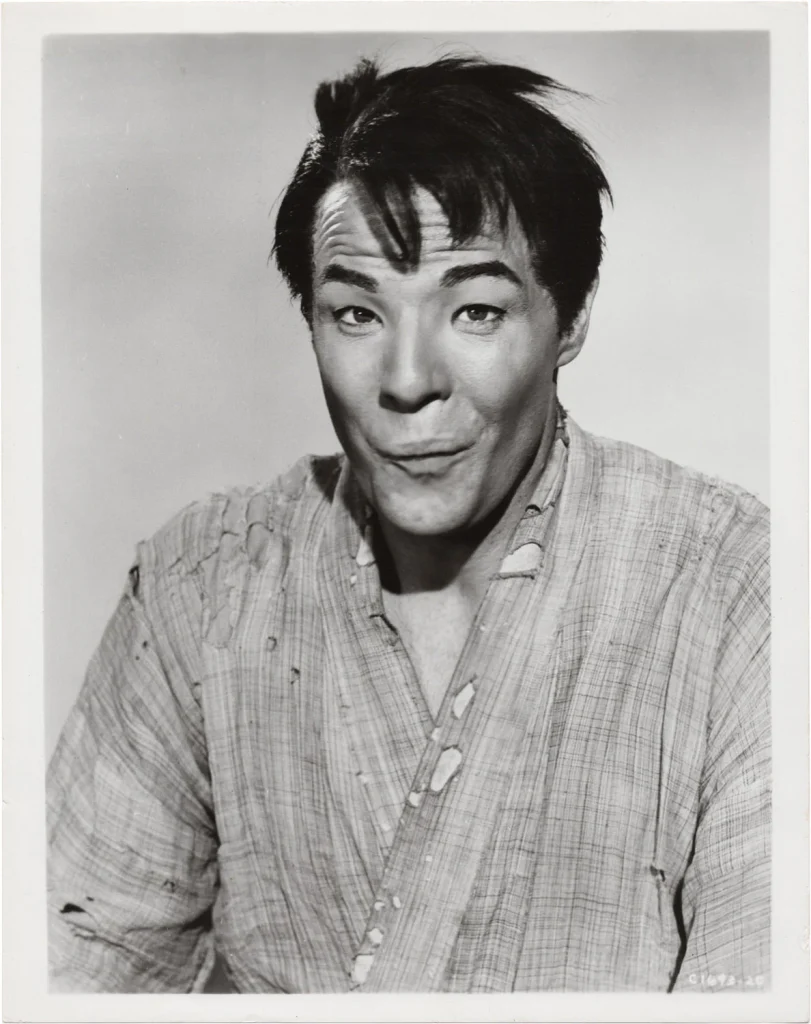
Hollywood and Broadway solved the “problem” of Asian men on stage and screen by turning them into harmless cartoons played by white actors in “yellowface” makeup. Under the strict Hollywood Motion Picture Production Code of the era, interracial romance was flatly forbidden. That is why in The King and I, the magnetic tension between Deborah Kerr’s Anna and Yul Brynner’s King can never become a real adult romance. Instead, the Asian monarch is desexualized and infantilized, reduced to a spoiled, overgrown boy who needs a white mother-figure to scold him, fix his grammar, and show him how to hold a woman’s waist during a polka.
Yul Brynner, a Russian-born actor who shaved his head and invented a choppy, broken-English cadence for his audition, won a Tony Award and an Oscar for the part. Just five years after the movie version of The King and I swept the Academy Awards, Hollywood served up another infamous yellowface caricature in the 1961 classic Breakfast at Tiffany’s: Mickey Rooney playing the buck-toothed, thick-glasses-wearing, yelling landlord Mr. Yunioshi.
At first glance, Brynner’s bare-chested King of Siam and Rooney’s screeching, slapstick Mr. Yunioshi seem worlds apart. Yet they are two sides of the exact same 1950s American coin. Both characters were built by white creators using broken English, exaggerated physical tics, and racial stereotypes to get laughs from Western crowds. Whether the Asian man was cast as an annoying neighbor in Manhattan or an absolute monarch in Bangkok, the message to 1950s audiences was identical: Asian men were loud, emotionally immature figures of fun meant to sit a tier below white Westerners.
Why the Play Still Hurts in Thailand
Put King Mongkut’s real life next to nineteenth-century Orientalism and 1950s Hollywood stereotyping, and it makes complete sense why the Thai government has banned performances and film screenings of The King and I for decades, and why ordinary Thais bristle whenever Westerners bring up the musical.
Even though Rodgers and Hammerstein wanted to write a story about two stubborn people learning to respect each other, their musical still wrapped colonial arrogance in gorgeous melodies and dazzling silk costumes. In the show, the King threatens to whip a young enslaved woman named Tuptim, a dramatic horror story Anna invented in her second book with zero historical evidence behind it.
Imagine if another country produced a wildly popular musical about Abraham Lincoln or Winston Churchill, portraying them as half-naked, grammar-mangling buffoons who needed a foreign nanny to teach them basic human decency. Almost anyone would find that insulting, especially when that leader was the exact person who protected their country’s independence.
In Thailand, the monarchy is woven deeply into national identity, Buddhism, and family respect. When King Mongkut’s son, King Chulalongkorn, the young prince taught by Anna who grew up to abolish slavery and complete Siam’s modernization, met Anna Leonowens in London in 1897, he looked her in the eye and asked a heartbreaking question. He asked why she had written such a wicked book about his father, telling her, “You made all the world laugh at him.”
Today, travelers who visit Thailand fall in love with how warm, welcoming, and fiercely proud Thai people are. You taste that pride in the meticulous craft of a royal dish like khao chae, where jasmine-scented rice is served with hand-carved vegetables and stuffed shallots. You feel it in the graceful wai greeting, where hands press together in mutual respect.
Thailand stands alone as the only nation in Southeast Asia never colonized by a Western power. That independence happened because a former Buddhist monk with a brass telescope, a stack of treaties, and a fierce devotion to his country outmaneuvered the largest empires on earth. Looking past the stage lights of The King and I finally lets us give credit to the real scholar-king who made modern Thailand possible.