
In Western pop culture, snakes usually end up playing the bad guy, lurking in the grass or tempting someone in an ancient garden. In Thailand, you show a serpent some real respect. You call them royalty.
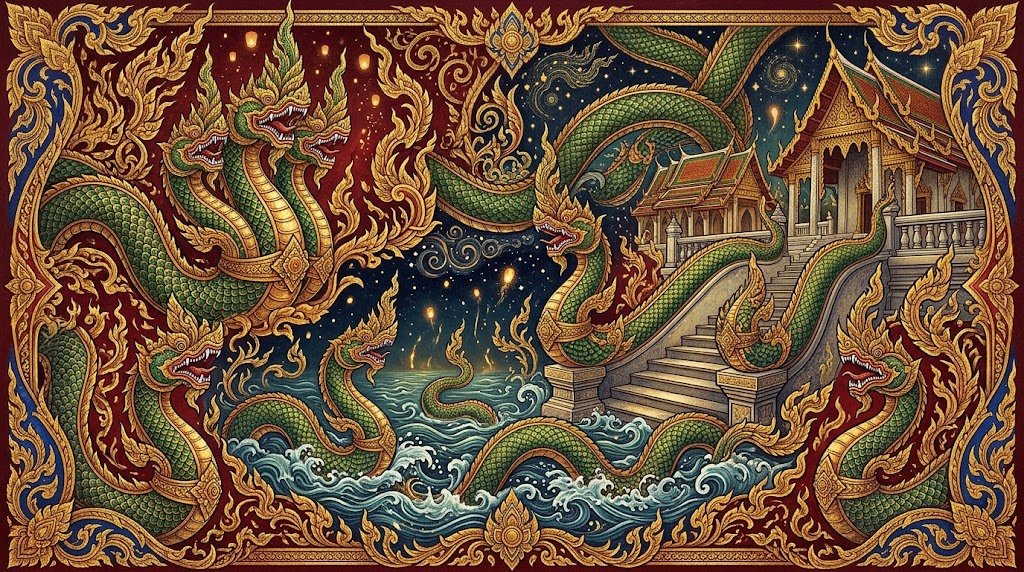
Deep under the churning, muddy waters of the Mekong and Chaophraya river systems lies Mueang Badan, the subterranean underworld ruled by the Phaya Nak (Naga). These aren’t your typical wandering forest spooks. They are semi-divine reptilian titans. Born out of ancient Vedic lore and woven right into everyday Thai Buddhism, state rituals, and village animism, the Nagas represent nature at its most majestic, unpredictable, and dangerous.
They guard temple steps, curl around monastery handrails, and pull monsoon clouds across dry farmland. But if you disrespect them—by dumping trash in a sacred stream, clearing a holy grove, or eating what belongs to the deep—they unleash an ancient fury that can drown entire towns in boiling mud.
What the Naga Means to Thais
To understand Thailand, you have to realize that the Naga isn’t just a bedtime story. It is woven into how Thai people farm, build sacred buildings, crown their royalty, and pray for luck. In late 2022, the Thai government officially declared the Phaya Nak as a national mythological creature, giving bureaucratic seal to a presence that has ruled the Siamese imagination for over a thousand years.
The serpent carries four huge pillars of symbolic power across everyday life:
First is water and agriculture. Thailand’s Central Plains and northeastern plateau run entirely on rice cultivation. Rice needs water, and water belongs to the Naga. In regional folklore, the number of Nagas playing in the celestial seas determines whether a year will bring plenty of rain or devastating droughts. The Ministry of Agriculture and Cooperatives still features the image of Phra Pirun (the god of rain) riding atop the back of a Naga as its official crest. When a farmer looks up at dark monsoon clouds gathering over the paddies, the winding lightning bolts aren’t just electrical discharges; they are celestial serpents dancing in the sky.
Second is the ultimate guardian of the Buddha’s teachings (the Dharma). In classic Buddhist lore, during the sixth week after Gautama Buddha attained enlightenment, a massive unseasonal storm battered the forest at Bodh Gaya. A great Naga king named Mucalinda slithered out from beneath the roots, wrapped his massive coils seven times around the meditating Buddha, and spread his wide serpent hood over the Buddha’s head like an umbrella to shield him from freezing winds and driving rains. This moment created the iconic Buddha posture known across Thailand as Phra Pang Nak Prok—the Buddha sheltered by the seven-headed Naga, which remains one of the most beloved and protective images in Thai sacred art.
Third is the sacred bridge between mortal desire and heavenly peace. Walk into virtually any monastery (wat) in Thailand, and you will climb wide outdoor stone staircases framed by massive, undulating serpent balustrades (Nak Sadung). Their heads flare at the base of the stairs, while their long, scaly bodies form the handrails leading right up to the front doors of the ordination hall (ubosot). This isn’t random decoration. The staircase represents Mount Meru, the center of Buddhist cosmology. Taking your first step between the open jaws of the Naga signifies leaving behind the muddy world of human attachments and climbing safely toward spiritual sanctuary.
Fourth is royal legitimacy and the cosmic ocean. In ancient Khmer-Siamese court traditions, the king is viewed as a chakravartin (a universal monarch) and an earthly incarnation of Lord Narayana. In royal ceremonies and classical architecture, royal barges, throne gables, and palace barges carry the fierce, upward-sweeping prow of the Naga. The serpent symbolizes the raw, untamed primal power of the cosmos, willingly coiled and serving as the seat of righteous, moral governance.
The Four Royal Lineages
Every single Naga coiling in the deep traces their roots back to four royal houses, separated by scale color, spiritual rank, and raw temper.
The golden Virupakkha sit right at the top. Ruled directly by Thao Virupakkha—one of the Four Heavenly Kings guarding Mount Meru—their scales shine like polished gold leaf. They don’t hatch from eggs; they appear out of thin air because of massive karmic merit. They live way up in heavenly clouds and celestial waters, and an angry glance from their eyes can fry lesser spirits on the spot.
The green-scaled Erapatha are the true masters of Southeast Asia’s rivers. These are the kings of the Mekong and Chaophraya, the spirits fishermen actually talk about bumping into through early morning river fog. They can shape-shift into refined courtiers draped in silk or stretch out as massive emerald-crested river serpents. They control seasonal flash floods, rainy season storms, and deep whirlpools that pull small wooden boats down into the dark.
The Chabbayaputta are the rarest of the bunch. Their scales shimmer with shifting, rainbow colors, almost like motor oil swirling on wet pavement. You’ll find them tucked away in deep crystal caverns and hidden dimensional pockets. They rarely care about human drama, preferring to spend centuries in deep, silent meditation. When they do slide across the sky, they leave surprise downpours and bright double rainbows behind them.
Down in the deepest trenches live the Kanhagotama. Covered in pitch-black, light-swallowing scales, these are the heavy enforcers and warriors of the mud vaults. They have a hair-trigger temper and lethal pride. Their breath spews corrosive venoms and choking black fogs. Old war songs say an enraged Kanhagotama is the only serpent down there tough enough to go toe-to-toe with the giant heavenly bird, the Garuda.
The Four Ways a Naga is Born
Just like spirits and gods, a human soul gets reborn as a Naga through a very specific karmic mix: living a life full of generous charity, but completely tangled up with stubborn pride, quick anger, or intense greed. They enter the water through four different doors:
First is Andaja, hatching out of clutches of eggs laid in cool riverbed mud. These serpents make up the giant army of river sentries and working-class water guardians.
Second is Jalabuja, born live from a mother serpent’s womb, just like a mammal. These become the noble court families that govern local streams and sacred lakes.
Third is Samsedaja, born straight out of rotting jungle mulch, hot mineral steam, and stagnant swamps. These serpents stay wild, feral, and elemental, claiming isolated swamplands where nobody dares to fish.
Fourth is Opapatika, appearing out of nowhere in a flash. They skip biology altogether, showing up fully grown with jeweled crowns and terrifying supernatural power thanks to mountain-sized piles of past-life merit.
The Five Unbreakable Curses
No matter how smooth a Naga looks while walking through a village market disguised as an attractive stranger, cosmic law sets down five absolute moments where all their magic cuts out, forcing them back into a giant snake:
The first moment is birth. The second they enter the world, they are purely a reptile.
The second moment is sleep. The instant a Naga passes out or falls into deep rest, every illusion drops. You’re left with a massive serpent coiled across the bedroom floor.
This rule created a famous monk ordination tradition in Thailand. Long ago, a clever Naga disguised himself as a human to ordain as a Buddhist monk. One afternoon while napping in his cell, his human body melted away, leaving a giant python sleeping on the mats. The Buddha had to ask him to leave the Sangha—not out of anger, but because animals simply cannot reach Buddhist enlightenment. To comfort the heartbroken serpent, the Buddha decreed that every young Thai man getting ready to ordain would forever be called a Naga (Nak) right up until the razor shaves his head and he puts on saffron robes.
The third moment is mating. Sacred law says physical intimacy can only happen in their true scaly skin.
The fourth moment is shedding. When peeling off old scales, a Naga is blind, exhausted, and completely defenseless.
The fifth moment is death. The instant the life cord snaps, every glamour vanishes. A dead Naga always leaves behind a massive, monstrous serpent carcass.
The Drowning of Chathida: The Tale of Phadaeng Nang Ai
You can see the raw fury of the deep written right across the dirt of Northeast Thailand (Isan).
According to the old story of Phadaeng Nang Ai, Prince Phangkhi, son of the powerful Naga king Phaya Suttho, fell hopelessly in love with the human princess Nang Ai. He turned himself into a stunning pure-white squirrel wearing a tiny golden bell and hopped into the royal palace gardens to get a closer look at her. A palace hunter spotted the animal and took it down with a poisoned arrow.
Before dying, the young prince cast a dying curse, forcing his tiny body of meat to multiply endlessly. The villagers chopped up the white meat and shared it across the entire walled city. Almost everyone took a bite, making the whole town guilty of eating Naga royalty.
That night, the sky cracked open with thunder. The ground tore apart with a sound like ripping iron as millions of black serpents exploded out of the dirt floors. The soil turned into liquid mud, dragging stone walls, timber palaces, and screaming crowds straight down into a boiling pit of water.
Today, that drowned city is Nong Han Kumphawapi, a massive freshwater lake in Udon Thani. Locals still paddle through its famous red lotus fields, knowing the ruins of a doomed kingdom are buried right under the silt.
Phaya Anantanakharat: The King of All Coils
At the center of everything sits Phaya Anantanakharat (Shesha-Naga), the boundless, nine-headed titan of the cosmic waters.
His giant, fire-crowned heads form the living umbrella that shades Lord Narayana while he rests during the dark night of the universe. His deep breathing keeps planetary orbits balanced in the sky, and his waking anger is the fire that burns everything to ash at the end of time.
Whenever you walk up the stone steps of a traditional Thai wat, those winding serpent handrails aren’t just artistic stone carvings. They represent Ananta’s long body acting as an energetic bridge, carrying you out of the messy dirt of human desires and up into the clean sanctuary of the temple.
Kham Chanod: The Floating Gateway of Si Suttho
Out in the Ban Dung district of Udon Thani sits Kham Chanod, a bizarre island of towering Chanod palm trees floating on top of a deep freshwater marsh.
Locals don’t treat this place like a casual park. They see it as an open doorway to the sunken palace of Chao Pu Si Suttho and Chao Ya Si Pathumma, the rulers of the Mekong serpents.
The island actually floats on a massive, springy mat of tangled tree roots, rising and falling with seasonal floods. The rules inside the grove are strict and non-negotiable:
Never carry away a single piece of wood, stone, or leaf. Never hunt birds or fish around the water’s edge. Never wear bright red clothes or noisy gold jewelry into the trees. And never, under any circumstances, use foul language or make fun of the unseen court.
People who break these rules don’t get a polite scolding from a park ranger. Stories across the region tell of rule-breakers coming down with mysterious, swollen bellies, sudden panic attacks, or dying quietly in their sleep—touched by the cold breath of the serpents guarding the root floor.
The Mekong Fireballs: The Return of the Buddha
Every October, at the end of the Buddhist Rains Retreat (Ok Phansa) on the full moon of the eleventh lunar month, thousands of people crowd the muddy banks of the Mekong River in Nong Khai and Bueng Kan.
Right out of the black, glassy water, glowing pinkish-red balls of light shoot silently up into the night sky. They don’t pop, they don’t leave any smoke, and they vanish high in the air without dropping ash.
Scientists like to blame pockets of marsh methane or stray tracer rounds fired from the opposite riverbank, but local river folk know the real story. In local belief, the fireballs (Bang Fai Phaya Nak) are underwater fireworks shot into the sky by the Naga kingdoms to light up the path as the Buddha walks back down to earth from heaven.
Boat captains keep their engines dead quiet and stay off the water during that full moon. When the kings of the deep are throwing a party for the Buddha, human boats need to stay parked on the shore.
The River Never Forgets
The Phaya Nak isn’t some dusty myth stuck in old library books.
They live on in the early morning fog hanging over the river, in the winning lottery numbers people search for on wet tree bark, in the young monks preparing for ordination, and in that sudden chill running down a diver’s spine when warm river water turns freezing cold out of nowhere.
They remind everyone living in a modern world of concrete highways and concrete dams that wild waterways belong to something much older than us. Down in the mud and the dark, the ancient scales are still moving—coiled in silence, watching the surface, and waiting for humans to forget who really owns the water.