


- 1960: The Surprising Scandinavian Partnership That Launched THAI
- The Visionary Builders Who Shaped Thai Airways
- Pioneering the Himalayas, Bali, and Ultra-Long-Haul Skies
- Floating Embassies of Thai Culture: Silk, Orchids, and Royal Hospitality
- Fun & Fascinating Trivia About Thai Airways
- Rebounding Into a New Era
Before Thailand could welcome tens of millions of travelers every year, export its cuisine to every corner of the map, or become a global creative powerhouse, people first needed a way to get there. Long before smartphones, global streaming, or international brand ambassadors existed, a sleek purple-and-gold jet bearing a blooming orchid tail fin carried the Kingdom of Thailand to the world.
Founded in 1960, Thai Airways International (THAI) did far more than sell airline tickets. Through bold aviation diplomacy, daring route pioneering, and unmistakable Siamese hospitality, a dedicated group of Thai and international aviation builders transformed Bangkok from a regional stopover into the indispensable crossroads of Asia, while collecting some of the best behind-the-scenes stories in commercial aviation along the way.
1960: The Surprising Scandinavian Partnership That Launched THAI
One of the best-kept secrets of Thai aviation history is that Thailand’s national flag carrier started out as a joint venture with Scandinavian Airlines System (SAS). In March 1960, Thailand’s domestic carrier, Thai Airways Company (TAC), teamed up with SAS, which initially held a 30 percent stake worth two million baht and provided aircraft, flight crews, and management training to build a world-class international airline from scratch. On May 1, 1960, THAI’s inaugural flight took off from Bangkok’s Don Mueang Airport aboard a propeller-driven Douglas DC-6B carrying 60 passengers bound for Hong Kong, Taipei, and Tokyo.
The partnership was designed from day one to transfer full leadership into Thai hands. By 1977, the Thai government had acquired all remaining SAS shares, and by 1987, foreign staff accounted for less than one percent of Bangkok-based personnel. Even after the buyout, the bond remained so close that THAI and SAS later reunited as two of the five founding members of Star Alliance in May 1997 alongside Lufthansa, Air Canada, and United Airlines.
The Visionary Builders Who Shaped Thai Airways
Behind every major leap from regional start-up to global aviation titan stood influential leaders who gave Thai Airways its commercial muscle, visual identity, and international stature:
- Niels Lumholdt: A legendary Danish aviation strategist seconded from SAS in the 1960s, Lumholdt stayed in Bangkok for decades as THAI’s commercial mastermind. Working hand in hand with Thai leadership, he engineered the airline’s intercontinental expansion into Australia, Europe, and North America and helped train an entire generation of Thai aviation executives.
- Chatrachai Bunya-Ananta: Often remembered as the charismatic architect of Thai Airways’ global brand, Chatrachai joined THAI in 1971 after an international career at BOAC and rose to become the airline’s first civilian President in 1992. He led the creative team behind the iconic purple-and-gold orchid livery, pioneered THAI’s global tourism blitz for the landmark 1987 “Visit Thailand Year,” and turned Bangkok into Southeast Asia’s premier long-haul transit hub.
- General Prem Tinsulanonda: Serving as Prime Minister of Thailand in April 1988, General Prem authorized the historic merger between international carrier Thai Airways International and domestic operator Thai Airways Company, uniting Thailand’s skies under a single national flag carrier and paving the way for its landmark Stock Exchange of Thailand listing.
- Thamnoon Wanglee: A thirty-one-year veteran of the airline who served as THAI’s President from 1993 to 2000, Thamnoon guided the carrier through Asia’s 1990s deregulation wave and represented Thailand on the global stage in May 1997 as one of the five founding chief executives who launched Star Alliance.
- Piyasvasti Amranand and Chai Eamsiri: When the 2020 global aviation shutdown pushed THAI into court-supervised rehabilitation, former president and chief plan administrator Piyasvasti Amranand worked alongside veteran aviation finance leader and current CEO Chai Eamsiri to streamline the fleet, absorb regional wing Thai Smile back into the mainline carrier, and return Thai Airways to profitability and Stock Exchange trading in 2025.
Pioneering the Himalayas, Bali, and Ultra-Long-Haul Skies
During the 1960s, 1970s, and 1980s, Thai Airways used smart, audacious route planning to put Bangkok right at the center of global travel:
- Asia’s First All-Jet Fleet (1966): Just six years after launching with propeller planes, THAI retired its piston aircraft and introduced five sleek French-built Caravelle SE-210 jets, earning the distinction of becoming the very first all-jet airline in Asia.
- Introducing Bali to International Jetsetters (1967): Long before Bali became an overcrowded bucket-list destination, THAI launched the first direct international flights to the Indonesian island in 1967 and actively promoted it worldwide.
- Conquering the Himalayas (1968): In December 1968, THAI made aviation history by pioneering commercial jet service into Kathmandu, Nepal, navigating treacherous mountain terrain to open the Himalayas to modern international travelers.
- Bridging Three Continents (1971–1980): THAI launched its first intercontinental route to Sydney in 1971, followed immediately by Copenhagen in 1972 and Frankfurt and London in 1973. In 1980, THAI crossed the Pacific to Seattle (and later San Francisco and Los Angeles), establishing Bangkok as the ultimate transit hub connecting Europe, Australia, Asia, and North America.
- The 17-Hour Nonstop New York Era (2005–2008): Using specially configured Airbus A340-500 jets, THAI famously operated nonstop marathon flights from Bangkok directly to New York (JFK) and Los Angeles, covering more than 8,600 miles in a single hop before skyrocketing jet fuel prices forced the airline to retire the ultra-long-haul route in 2008.
Floating Embassies of Thai Culture: Silk, Orchids, and Royal Hospitality
What truly made Thai Airways an instrument of Thai soft power was how deeply it embedded local culture into every detail of the passenger experience. Stepping aboard a THAI jet felt like entering Thailand hours before landing.
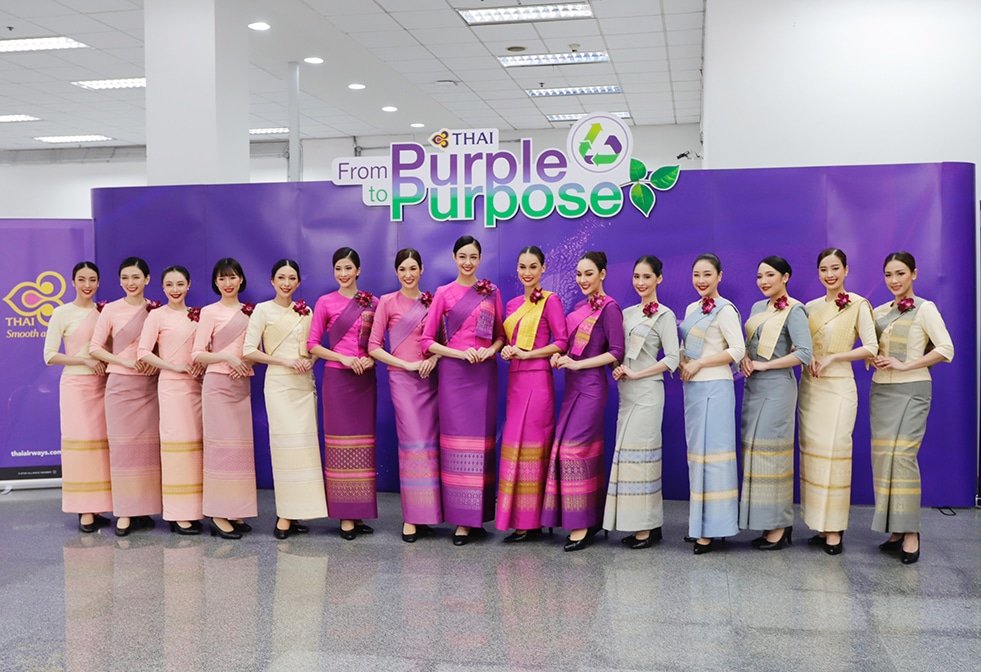
Cabin crew welcomed guests with a graceful wai and handed every passenger a fresh purple orchid corsage, a tradition inspired by the airline’s famous “Smooth as Silk” philosophy. Female flight attendants famously changed into traditional Thai silk Chud Thai outfits once in flight, designed originally with guidance from royal designer Prince Kraisingh Vudhijaya. Even the airline’s visual identity evolved from its playful 1960 “Dancing Man” logo (Chao Phraya) into the iconic purple, magenta, and gold Champa orchid tail fin created in 1975 by renowned graphic designer Walter Landor.
Meanwhile, THAI’s massive Bangkok Flight Kitchen, opened in 1989 as the largest and most modern airline catering facility in Asia, introduced millions of international travelers to authentic Thai curries, Pad Thai, and tropical fruits at 35,000 feet, while also preparing meals for more than forty other international airlines. Its iconic inflight magazine, Sawasdee (first published in 1971), introduced generations of readers to Thai art, temples, and hidden regional destinations.
Fun & Fascinating Trivia About Thai Airways
Behind the scenes of sixty-plus years of flight, Thai Airways has racked up some truly unforgettable trivia:
- Every THAI Plane Receives a Royal Name: Unlike airlines that simply number their jets, Thai Airways christens its aircraft with official royal names bestowed by the Thai monarch, such as Alongkorn, Srisoonthon, and Sri Ayutthaya, painted gracefully near the nose of each fuselage.
- Thai Airways Reached the Summit of Mount Everest: On May 23, 1997, Tashi Tenzing, grandson of legendary Everest pioneer Tenzing Norgay, carried the official Thai Airways flag all the way to the 29,032-foot summit of Mount Everest.
- Special VIP Panda Charters: In October 2003, THAI operated a custom, temperature-controlled charter flight to safely transport beloved giant pandas Chuang Chuang and Lin Hui from Chengdu, China, to their new home at Chiang Mai Zoo.
- Royal Barge Flying Artworks: To honor major royal milestones, including King Bhumibol Adulyadej’s 72nd birthday in 1999 and King Maha Vajiralongkorn’s coronation in 2019, THAI painted wide-body Boeing 747 and Boeing 777 jets in breathtaking full-fuselage liveries depicting the golden Suphannahong Royal Barge.
- Bangkok’s Very First Duty-Free Shop: In 1973, long before airport luxury malls became standard, Thai Airways opened the first duty-free shop at Bangkok’s Don Mueang International Airport.
- The Pandemic Pop-Up Restaurant That Went Viral: When global borders closed in 2020 and planes were grounded, THAI turned its Bangkok head-office cafeteria into an airplane-themed pop-up restaurant complete with real aircraft seats, boarding-pass menus, and cabin crew serving business-class dishes, drawing thousands of nostalgic locals lining up for a taste of flying.
- The “TG” Code Mystery: Ever wondered why Thai Airways uses the two-letter IATA airline code TG? It stands for Thai-Gai (or Thai Global in modern branding), dating back to the early days when internal radio operators used phonetic shorthand to distinguish international flights from domestic Thai Airways Company (“TH”) flights.
Rebounding Into a New Era
After emerging from its court-supervised rehabilitation in June 2025 and resuming trading on the Stock Exchange of Thailand in August 2025, Thai Airways entered 2026 operating a streamlined fleet of roughly 80 aircraft serving dozens of destinations across Asia, Europe, and Oceania while reclaiming its place among the world’s top ten international airlines.
More than six decades after its first propeller plane lifted off from Bangkok, Thai Airways remains an enduring symbol of Thailand’s global spirit, proving that when a nation shares its warmth, artistry, and hospitality with the sky, the whole world wants to come visit.