
Pick up an airline seatback magazine or flip through a travel feature, and the global Thai footprint is instantly recognizable: warm hospitality, world-class cuisine, and an extraordinary ability to turn any corner of the world into a welcoming community.
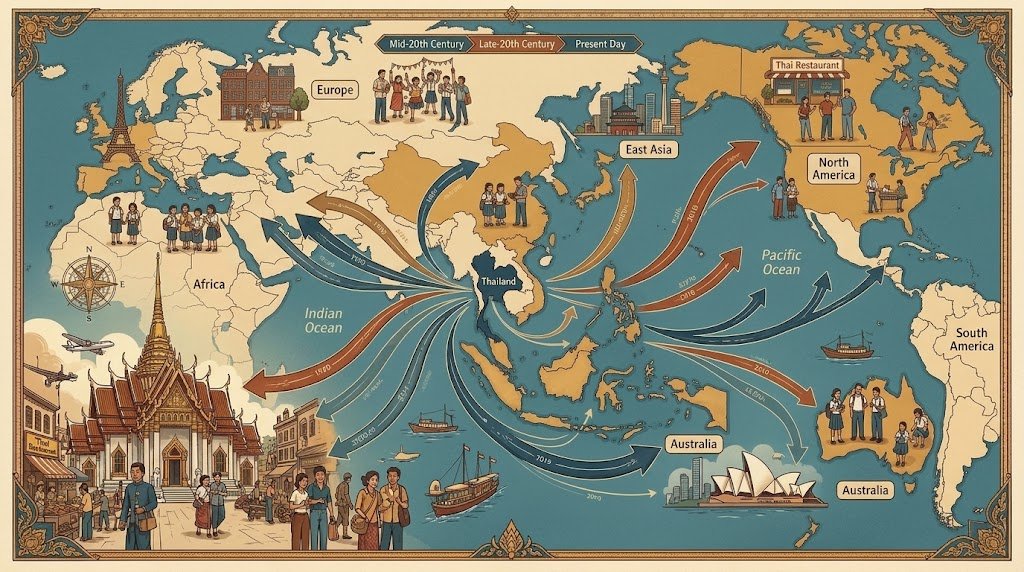
Yet behind the iconic dishes and vibrant festivals lies an even more compelling story of resilience, ingenuity, and cultural pride.
Thailand stands out in modern history as an independent kingdom that charted its own course without colonial rule. That independence gave its citizens a unique self-reliance. When Thais ventured abroad over the past six decades, they carried with them an innate adaptability, strong family values, and an entrepreneurial spark.
From Isan farmers introducing specialized seasonal agricultural expertise to northern Europe to multi-generational Sino-Thai families building international supply chains in California, the Thai diaspora is a dynamic mosaic of dreamers, builders, and cultural ambassadors. They remain bound together by a deep love for their heritage, the comfort of authentic home cooking, and a shared dedication to uplifting their families across generations.
The Visionary Pioneers: Scholars, Physicians, and Modernization
The foundation of modern Thai engagement with the world was built on royal vision and educational excellence.
Beginning with King Chulalongkorn (Rama V), Thailand recognized that learning from global partners was vital for modern statecraft and scientific progress. By the mid-20th century, this tradition expanded through prestigious royal programs—most notably the Thun Luang (King’s Scholarship) and private endowments, sending the nation’s brightest minds to top institutions like Harvard, Columbia, Oxford, and the London School of Economics.
These scholars excelled in civil engineering, economics, healthcare, and statecraft. While many returned to take leadership roles across Thai ministries and universities, many others served as vital cultural and professional liaisons abroad.
During the global expansion of medical systems in the late 1960s and 1970s, Thai doctors and nurses became widely respected pioneers in the United States and Europe. Hospitals in major hubs like Chicago, New York, and Philadelphia welcomed hundreds of Thai medical residents known for their meticulous technique, gentle bedside manner, and tireless work ethic. These professionals established the foundational pillars of the overseas community, earning deep respect in their adopted hometowns while maintaining close, proud connections to Thailand.
The Diplomatic Bridge: The Rise of Consular Support
As commercial opportunities drew more Thais overseas, Thailand’s diplomatic infrastructure evolved rapidly to support its growing global family.
Historically focused on bilateral treaties and high-level statecraft in capitals like Washington, London, and Paris, Thailand’s Ministry of Foreign Affairs recognized the need for localized community support. A major milestone arrived in July 1971 with the official opening of the Royal Thai Consulate-General in Los Angeles on Wilshire Boulevard.
Recognizing that Southern California had become the largest gathering place of Thais outside the kingdom, the Royal Thai Government established a modern civic lifeline that redefined community service:
- Essential Civic Services: The consulate streamlined documentation, ensuring that Thai citizens overseas could easily renew passports, register vital family records, and maintain dual citizenship rights for their foreign-born children.
- The Mobile Consulate Outreach (Kongsun Sanchon): To bridge geographic gaps, consular teams pioneered traveling mobile units. Equipping vehicles with biometric systems, official seals, and documentation tools, teams journeyed to temple halls and civic centers from Florida to Texas, Nevada, and across Europe. For elders and remote families, these visits brought sovereign Thai care straight to their doorsteps.
- Welfare and Cultural Advocacy: Consular networks actively collaborated with local community associations, providing emergency aid, supporting cultural festivals, and partnering with civic leaders to protect the rights, dignity, and wellbeing of Thai workers everywhere.
The Tila Family: Laying the Foundations of LA’s Thai Town
The culinary revolution that introduced authentic Thai flavors to the Western hemisphere found its catalyst on Hollywood Boulevard in 1972: Bangkok Market.
Before Pramorte and Marasri Tilakamonkul (the parents of celebrity chef Jet Tila) established roots in Los Angeles in the late 1960s, finding true Thai ingredients was nearly impossible. Home cooks relied on inventive substitutions to recapture the beloved flavors of kaffir lime, holy basil, and bird’s eye chilies.
The Tila family changed the landscape through vision and sheer determination:
- Pioneering the Supply Chain: Opening Bangkok Market on Melrose Avenue before expanding to Hollywood Boulevard, the Tilas established the first dedicated Thai grocery store in the United States. Pramorte built import routes that brought authentic jasmine rice, pure fish sauce, aromatic curry pastes, and fresh regional produce directly from Bangkok to the American West Coast.
- A Community Haven: In the 1970s and 1980s, Bangkok Market was the heartbeat of the arriving community. It was a lively gathering place where newcomers found housing boards, connected with job networks, shared home news, and found a comforting taste of home.
- Igniting the Restaurant Boom: When the family launched Royal Thai Cuisine, they provided an inspiring commercial blueprint. By providing commercial woks, authentic ingredients, and wholesale distribution, they empowered hundreds of entrepreneurial families to open their own thriving restaurants.
Jet Tila grew up learning the craft on that market floor, mastering regional flavors and understanding the value of family heritage. When he took those traditions to national television, celebrating the delicate harmony of sweet, sour, salty, and spicy, he showcased the entrepreneurial triumph of an immigrant family who helped define modern American food culture.
Community Leadership and the Birth of Thai Town
As the community grew, civic leadership flourished alongside commerce.
Visionary organizers like Chanchanit “Chancee” Martorell recognized that cultural strength and civic empowerment go hand in hand. Founding the Thai Community Development Center (Thai CDC) in 1994, Martorell mobilized community members, legal advocates, and local government partners to champion social equity, small-business development, and affordable housing.
Their tireless advocacy led to a historic milestone in October 1999, when the Los Angeles City Council officially designated a six-block stretch of East Hollywood as the world’s first recognized Thai Town.
Today, Thai Town stands as a vibrant cultural landmark, featuring the iconic golden Kinnari street lamps, bustling bakeries, world-class eateries, and community centers that celebrate Thailand’s enduring cultural contributions to the global fabric.
Pioneers Who Shaped the Global Community
The overseas Thai story spans continents, driven by passionate trailblazers who established cultural sanctuaries worldwide:
- The Spiritual Anchor of Wat Thai of Los Angeles: In the early 1970s, community elders and Bangkok’s Sangha leadership joined hands to establish Wat Thai of Los Angeles in North Hollywood. It grew into a magnificent cultural and spiritual sanctuary. For over five decades, it has hosted traditional language and classical music schools, nurtured generations of youth, and welcomed millions of visitors to its legendary weekend courtyard street-food fairs.
- The Northern European Enterprise: In Sweden and Finland, Thai families transformed rural agricultural partnerships into thriving regional industries. Starting in the 1980s, Isan families brought their unmatched discipline and outdoor knowledge to northern taiga forests. Today, seasonal berry harvesting represents a collaborative economic bridge, allowing families to build financial security, fund educational dreams, and invest back into their home communities.
- The UK Culinary Pioneers: Visionaries like Phaibul “Mini” Patel, who helped launch landmark restaurants like Chiang Mai in London’s Soho during the 1980s, introduced the British public to the authentic complexity of traditional Thai dining. Their success paved the way for bilateral culinary visas, making Thai cuisine an indispensable treasure of British dining culture.
- Cultural Preservation Abroad: Dedicated educators, monks, and artists across Tokyo, Sydney, Paris, and Vancouver have continuously built archives, established cultural dance troupes, and hosted Songkran celebrations, creating an open window for the world to experience the warmth of Thai traditions.
The New Creative Frontier: Modern Global Innovators
Today, a confident new generation of Thais abroad is breaking ground in cutting-edge industries.
Backed by world-class education and regional pride, young Thai professionals are excelling as software architects in Berlin, healthcare researchers in Melbourne, luxury fashion designers in Paris, social media influencers in every corner of the globe and digital animators in North America. They embrace their bilingual and multicultural fluency, viewing their heritage as a creative superpower.
Modern chefs in New York, London, and Tokyo are taking Thai culinary arts to fine-dining heights, showcasing fiery southern curries and complex fermented northeastern specialties with absolute authenticity. Meanwhile, young diaspora creators utilize digital platforms to share the warmth of Thai hospitality with global audiences, demonstrating that Thai soft power is vibrant, contemporary, and universally beloved.
The Enduring Legacy of Bunkhun
At the center of the overseas journey remains the timeless cultural value of bunkhun (บุญคุณ), the deep, loving gratitude and respect owed to parents, family, and heritage.
Whether running an acclaimed kitchen in Manhattan, designing sustainable architecture in Sydney, or managing community programs in London, overseas Thais maintain an unbreakable bond with their roots. They invest back into their home provinces, support temple restorations, fund scholarships for young relatives, and return home with hearts full of pride.
The story of the Thai diaspora is a celebration of warmth, dignity, and quiet strength. Through hard work, deep-seated family values, and an enduring commitment to their roots, Thais around the world have transformed distant cities into welcoming homes, enriching global society while keeping the proud spirit of Thailand shining brightly across the globe.