


Walk down almost any soi in Bangkok and you’ll pass a tiny, ridiculously ornate little house sitting on a pedestal. Could be outside a glass office tower on Sukhumvit, wedged next to a noodle cart in Ari, or tucked behind a 7-Eleven in Silom. Most of them are draped in fresh marigold garlands, smoking with incense, and most noticeably stocked with open bottles of red Fanta with a bendy straw sticking out of it.
If you’re visiting Thailand for the first time, a spirit house (san phra phum) just looks like cool traditional decor. If you grew up here, it’s basically paying rent to your invisible neighbors. You share the block with spirits, so you give them snacks, keep the peace, and hope nobody gets mad. And if a ghost is hanging around somewhere it really shouldn’t be? Thai people have a surprisingly polite phrase to shoo it away. You tell it to go thi chop thi chop.
Literally, it translates to “the place you like” or “a peaceful place.” In everyday Thai superstition, saying pai thi chop thi chop is basically wishing a lingering spirit well so it’ll move on to a nice afterlife and stop haunting the living room. Nobody’s screaming at demons or waving crucifixes around. You’re just gently nudging a ghost toward the door because hanging around an old house is depressing for everyone involved.
That exact cultural reflex is the whole premise of “ที่ชอบที่ชอบ (Grief Eaters),” the October 29, 2026 single from Thai rock-pop star Jeff Satur, starring pop singer and actress ALLY (Achiraya Nitibhon) in its moody sci-fi video.
Even if you’re just reading the English subtitles and watching it as a sleek futuristic breakup story, the track wrecks you. Jeff’s voice goes from this fragile, raspy whisper into a huge rock-ballad belt, carried along by Thai piano legend Tor Saksit. Meanwhile, ALLY brings this quiet, lived-in warmth to the screen where even a two-second glance feels like ten years of deep emotional baggage.
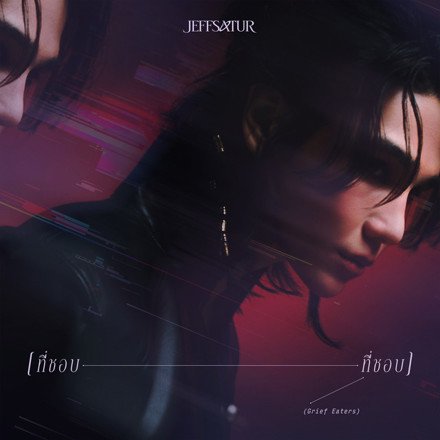
Once you know what thi chop thi chop actually means in daily Thai life, though, the whole concept flips upside down. Jeff took a phrase meant to banish ghosts and turned it inside out. He wrote a song about willingly feeding your own heartbreak, pulling up a chair for it at dinner, and flat-out refusing to let a memory leave.
A Weirdly Brave First Move
Timing is everything in T-Pop, and “Grief Eaters” landed at a pretty huge career pivot. On October 21, 2026, Jeff Satur officially signed with Universal Music Southeast Asia under Universal Music Thailand, a big global leap after years of building a rabid international fanbase through acting, world tours, and his own studio work. Eight days later, he dropped “Grief Eaters” as his debut single under the new deal.
Usually, when an artist inks a massive major-label partnership, the debut single is a shiny, safe radio track built for TikTok dances or stadium chants. Jeff went full sad-boy instead. He wrote, composed, and produced the track himself alongside lyricist Pluviophile, delivering a slow-burn, intensely Thai meditation on grief. Honestly, that’s probably why international fans obsess over him in the first place.
Born Worakamol Satur in Bangkok back in 1995, Jeff spent nearly ten years grinding behind the scenes in the Thai music industry before blowing up globally. He bounced between labels, wrote commercial jingles, worked as a barista, and learned production from scratch. By the time the rest of the world found him playing Kim in KinnPorsche back in 2020 or through tracks like “Fade” and “Dum Dum” his sound was already locked in. He mixes Western alt-rock drama and R&B runs with lyrics rooted deep in Thai emotional nuance.
On “Grief Eaters,” he ditches the leather jackets and pyrotechnics. What’s left sounds like a guy sitting alone at his kitchen table at 3 AM, staring at an empty chair while trying to fill the emptiness he feels inside with Mama noodles.
Why Thai People Feed Their Ghosts
To really get why the song hits Thai listeners so hard, you have to look at how Thailand treats food and the dead.
In Western movies, ghosts are scary squatters and you burn sage, call a priest, and sprint out the front door. In Thailand, where Theravada Buddhism blends seamlessly with older animist beliefs and Brahmanist rituals, spirits are just part of the extended neighborhood. You don’t starve a ghost to make it leave. You give it something sweet.
Pass a neighborhood shrine in Bangkok’s old town or a roadside memorial after a bad crash, and you’ll see plates of steamed rice, peeled bananas, boiled eggs, and glasses of sweet red soda lined up neatly on the concrete. When Thai families go to the temple in the morning to make merit (tham bun), they pack tiffin carriers with their late relatives’ favorite curries and desserts, offering them to the monks so the spiritual nourishment passes on to whoever died. And we do this because in Thailand, food is how you say I haven’t forgotten you.
Look at the English title Jeff paired with the Thai phrase: “Grief Eaters.” That contrast is brutal. If thi chop thi chop is the polite wish for a spirit to go find peace somewhere else, “Grief Eaters” is what happens to the person left behind who refuses to say goodbye. You turn into something that survives by chewing on old memories. Every shared meal, every street stall you walk past, every random midnight craving becomes a tiny ritual keeping someone alive in your head.
In Bangkok, memory is basically glued to flavor. You go through a breakup and suddenly you can’t walk past the khao man gai cart near BTS Ari without remembering how they always asked for extra ginger-chili sauce. You actively avoid the bua loy stall in Yaowarat because you used to split a bowl there after midnight movies. Even a plastic bag of iced Thai tea tied up with a rubber band carries emotional baggage.
Jeff’s lyrics walk straight into that trap. He’s singing about a presence that stays right next to you, warm and familiar, even though the relationship is dead and buried. Telling that memory to go thi chop thi chop makes total sense on paper, except your heart keeps setting out an extra plate.
Enter ALLY: Daylight in a Sci-Fi Loop
Jeff Satur naturally brings a gothic, slightly brooding energy to almost everything he does, so casting ALLY as his co-star in the video was a seriously smart call.
If you’re still getting into T-Pop, ALLY is basically Thai pop royalty. Born in 2004, she grew up around the industry as the daughter of actor Amarin Nitibhon and former singer Joy Achariya. Rather than coasting on her last name, she moved to South Korea as a teenager to train in vocals and dance before debuting in Thailand in 2020 with the massive hit “How To Love” featuring Gray. Over the last few years, she’s grown from a teen prodigy into a super poised artist and film actress. She doesn’t sing a single note on the “Grief Eaters” studio track, yet she carries half the emotional weight of the release.
When teaser photos of Jeff and ALLY dropped in late October 2026, everyone assumed they were releasing a duet. They gave us something much weirder and sadder instead. The music video leans hard into melancholic sci-fi, think Her or Blade Runner 2049, building a quiet world where memory, virtual reality, and plain old loneliness bleed into each other.
Watch ALLY’s face in the close-ups. While Jeff plays the haunted stillness of a guy stuck in a loop, ALLY feels like real sunlight. She moves through the scenes with this effortless, unforced ease laughing quietly, sharing tiny domestic moments, radiating the exact kind of ordinary warmth that makes losing someone feel unbearable afterward. When the video’s sci-fi twist slowly reveals what’s actually going on between them, leaving you wondering who’s the ghost and who’s just a simulated memory, ALLY’s quiet restraint makes the ending sting twice as much.
When the behind-the-scenes featurette came out on November 23, 2026, fans got to see how fast the two clicked off-camera. The second the director yelled cut, all the existential gloom evaporated. Jeff and ALLY were cracking jokes, geeking out over camera framing, and hanging out with this easy, sibling-like energy that made the heavy emotional scenes work way better once the cameras rolled again.
Tor Saksit and the Sound of 2 AM
You also can’t talk about why this track works without bringing up the third heavyweight in the studio: Tor Saksit Vejsupaporn.
Ask any Thai millennial or Gen Z kid to name the soundtrack to their worst high school breakup, and Tor Saksit’s name will come up in under ten seconds. A classically trained pianist who ruled the Thai charts in the late 2000s with classics like “Rak Ter” (“Love You”), Tor has a signature touch on the keys. He knows how to let one chord hang in the air just long enough to make your chest ache before he resolves it. Having him play piano on “Grief Eaters” bridges Jeff’s futuristic global T-Pop sound with twenty years of classic Thai ballad DNA.
Put on good headphones and listen to the intro. It opens super sparse, almost like footsteps walking into an empty apartment. Tor’s piano doesn’t rush to fill up the room like an overture, it leaves huge pockets of silence around Jeff’s lower register so you can hear every bit of grit in his voice. When the strings and drums finally swell around the bridge, it turns from a quiet bedroom confession into something massive. Still, the piano stays dead center in the mix like a steady pulse reminding you that no matter how modern the production gets, heartbreak feels the exact same way it did twenty years ago.
The Comfort Food Paradox
There’s a funny contradiction about Thailand that most travelers notice within forty-eight hours of landing. On the surface, it’s the “Land of Smiles” easygoing, loud street markets, playful banter, and communal eating. Sit down at a metal folding table on Soi Thonglor or by the river in Chiang Mai, and strangers will point out the best dish on the menu, pass you the chili vinegar, and laugh with you over broken Thai and English. Then you turn on Thai radio or watch a Thai drama and realize the country makes some of the most devastatingly sad breakup songs on earth.
Thai listeners call this whole vibe nueng or “depress listening,” and it works almost identically to late-night comfort food. Nobody in Bangkok orders a fancy ten-course dinner when they just got dumped. You walk down to the corner stall at 1 AM and get a steaming bowl of khao tom kui, plain boiled rice soup, with simple side dishes: salty preserved radish fried with egg, crispy morning glory blasted over a roaring wok, or braised pork belly.
It’s warm, simple, a little salty, and completely familiar. It won’t fix your life, obviously, but it sits warmly in your stomach while you stare at the wall and process things.
“Grief Eaters” sits right in that sweet spot. Jeff Satur isn’t handing out a peppy anthem telling you to hit the gym, block your ex, and move on by Monday. That kind of aggressive positivity feels weirdly foreign to Thai pop anyway. Instead, the song pulls up a plastic stool next to you at the late-night noodle cart, admits that the ghost of someone you loved is still sitting across the table, and confesses how hard it actually is to say pai thi chop thi chop.
If you’re finding T-Pop from the other side of the world, tracks like “Grief Eaters” give you a peek into everyday Thai psychology that no travel blog ever touches. Next time you put it on or rewatch the video, keep an eye out for a few things hiding in plain sight:
- The Title Hook: Every time Jeff sings thi chop thi chop in the chorus, listen to how soft he goes on the pronunciation. He sings it almost like a lullaby rather than a goodbye, nailing that exact hesitation when you know you need to let a memory go, even though you really don’t want to close the door.
- The Empty Space: Watch how the video uses weird glass reflections, empty rooms, and isolated framing between Jeff and ALLY. Even when they’re standing three feet apart, the camera makes it feel like they’re on slightly different frequencies, a nod to that invisible wall between the living and the spirit world in Thai folklore.
- Skip the Morning Commute: Don’t listen to this on a crowded train while answering emails. Put it on during a quiet walk at night or while eating something warm at home. Like midnight khao tom after a Bangkok rainstorm, it’s meant to sit with you for a bit.
That’s really why “Grief Eaters” cuts through all the noise in 2026. Plenty of pop stars can hit big high notes or hire a slick film crew for a moody video. Almost nobody else can take a four-word piece of everyday Bangkok ghost manners, pair it with ALLY’s quiet warmth and Tor Saksit’s piano, and turn personal heartbreak into a shared midnight meal.
Sometimes, before you can finally wish a ghost well and send it on to thi chop thi chop, you have to sit down, share one last plate of memories, and let yourself miss them.