

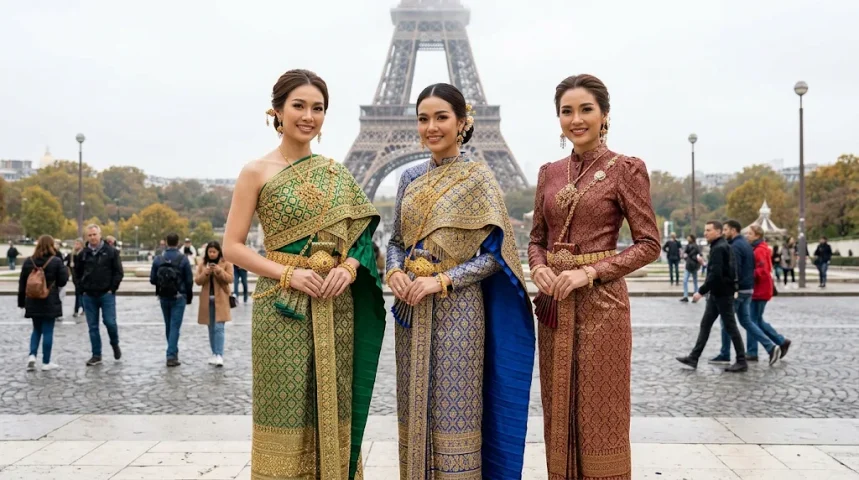
Most people picture the golden palace halls of Bangkok or tourists renting shimmering silk outfits when they think of the Chud Thai. It looks ancient, like something straight off a temple wall painted five hundred years ago. The reality catches a lot of people off guard: Thailand’s national costume is actually a clever mid-century invention.
In the late 1950s, Thailand had no unified national dress. Japan had celebrated the kimono for generations and India wore the sari with pride, but Thai closets were empty of an official equivalent. It took a young queen, a team of palace scholars, and legendary French designer Pierre Balmain to build one from scratch. What began as a wardrobe dilemma ahead of a massive diplomatic tour grew into one of Southeast Asia’s greatest craft revivals.
Before modern tailoring caught on, nobody cut patterns or ran sewing machines across ancient Siam. People practiced a style called nung hom, which translates directly to “wrap below, drape above.”
Dressing was pure geometry and friction. Men and women wrapped a long strip of unstitched cotton or silk around their waists, twisted the loose fabric between their legs, and tucked the roll into their lower back. That gave them the chong kraben, a pair of loose, pleated trousers ideal for wading through canals, climbing into wooden boats, and working in tropical heat.
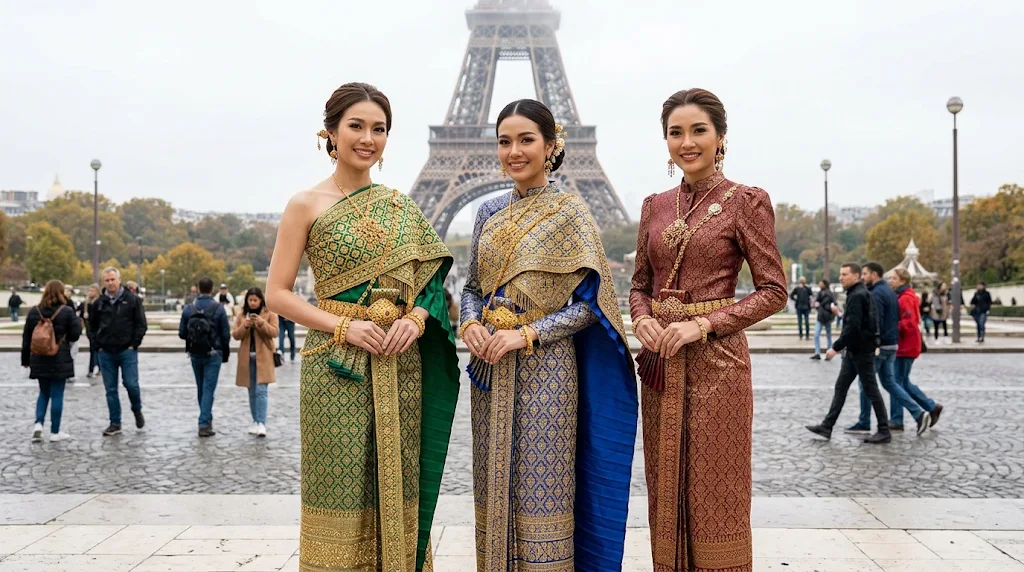
Women draped an unfastened silk scarf called a sabai diagonally across their chests, letting the tail cascade over one shoulder. If someone wanted to flaunt their wealth, they showed it through the textile itself. Everyday farmers wore tough, homegrown cotton, while nobles dressed in imported Indian block prints or heavy brocades shot through with genuine gold thread. That whole tradition fell off a cliff in the twentieth century.
European colonial powers were circling Siam in the late 1800s, often treating non-Western clothing as proof that a kingdom was backward and ripe for outside rule. Siamese royalty pushed back by adopting blended styles, such as crisp high-collared jackets paired with traditional wraps.
Real disaster struck between 1939 and 1944 under the military regime of Field Marshal Plaek Phibunsongkhram. Trying to make Thailand look like an industrial powerhouse overnight, the state passed strict cultural mandates. Officials banned traditional wraps from public life. Men had to wear trousers and neckties; women had to put on Western skirts, modern blouses, and hats. Anyone who dared board a public bus or enter a government office in traditional cloth was turned away. In just a few decades, village handlooms gathered dust, and ancient wrapping techniques slipped out of everyday memory.
The turning point arrived in 1960. King Bhumibol Adulyadej and Queen Sirikit were gearing up for a grueling six-month tour through fourteen Western countries. As Queen Sirikit planned her travel wardrobe, she noticed an awkward problem: she had no official Thai outfit to wear alongside foreign monarchs and presidents.
Instead of buying standard European ballgowns and calling it a day, Queen Sirikit launched a cultural rescue mission. She studied historical textiles from old kingdoms like Sukhothai and Ayutthaya alongside royal historians, then collaborated with French couturier Pierre Balmain. Together, they took historical drapery and re-engineered it for modern life. They added hidden waistbands, fitted bodices, and discreet back zippers so someone could get dressed in five minutes without worrying about a pleated wrap unraveling at a dinner party.
The result was the Chud Thai Phra Rajaniyom (“Thai Outfits of Royal Favor”), eight tailored silhouettes built for specific times of day and formalities:
- Thai Ruean Ton: A relaxed daytime outfit with a collarless, button-up blouse and a striped cotton or silk sarong, worn for merit-making and casual temple visits.
- Thai Chitralada: A structured daytime silk suit with a mandarin collar, five front buttons, and a matching skirt, widely worn for official meetings and state ceremonies.
- Thai Amarin: An evening ensemble cut from rich silk brocade without an added waist sash, leaving the chest clean for royal medals and formal jewelry.
- Thai Boromphiman: A grand, high-collared formal evening gown with long sleeves and a neat front skirt pleat, frequently worn for traditional weddings.
- Thai Dusit: A wide-scoop, sleeveless gown decorated with embroidery and sequins, pairing traditional silk with the drama of a classic Western gala dress.
- Thai Chakri: The most famous look in the collection, featuring a bare shoulder and an accordion-pleated sabai that sweeps across the torso down to the floor.
- Thai Siwalai: A warm, high-necked gown paired with an embroidered shoulder scarf, reserved for high-stakes royal ceremonies.
- Thai Chakraphat: The grandest palace silhouette, featuring double-layered scarves loaded with heavy metallic thread, sequins, and royal jewelry.
Later, men received their own standardized counterpart in the Suea Phraratchathan, a tailored mandarin-collar jacket that pairs naturally with trousers, eliminating the need for a Western tie at formal events.
While tourists admire the finished dresses, the heartbeat of the costume stays rooted in the countryside.
In 1976, Queen Sirikit founded the SUPPORT Foundation to give rural families a reliable off-season paycheck through handloom craft. The project pulled endangered regional methods back from the brink:
- Mudmee: A complicated tie-dye ikat technique from northeastern provinces like Khon Kaen and Surin, turning simple village cloth into world-class luxury silk.
- Pha Yok Thong: A heavy gold brocade where two or three weavers sit together at a wooden loom, hand-lifting hundreds of guide threads to finish a single meter over several days.
- Pha Tin Chok: Intricate northern Lanna skirts where weavers work color into geometric patterns using porcupine quills or bone needles.
- Natural Dyes: Boiling indigo leaves for deep blues, fermented ebony fruit for black, wild lac bugs for rich red, and turmeric roots for gold.
The Thai government’s push to secure UNESCO Intangible Cultural Heritage status for the Chud Thai highlights this living community knowledge. The goal is keeping generational skills alive, guaranteeing fair wages for aging village weavers, and drawing a hard line between genuine handwoven textiles and cheap polyester copies from fast-fashion apps.
Pop culture has also helped hand these traditions down to younger crowds. Blockbuster historical dramas like Love Destiny triggered a massive youth revival, turning traditional silk into a popular style choice for weekend temple trips, festivals, and graduation celebrations.
The Chud Thai holds onto its power because it reflects modern Thailand: ready to adapt, proud of its local craft, and completely comfortable standing on its own terms.