

- 1. Chili Peppers (Prik): From Mesoamerican Jungles to Thai Fire
- 2. Green Papaya (Malakor): The Caribbean Fruit That Became Isan’s Greatest Salad
- 3. Peanuts (Thua Lisong) and Cashews (Met Mamuang Himaphan): South American Crunch Meets Thai Street Woks
- 4. Tomatoes (Makhuea Thet): Look at the Clue Hidden in the Thai Name
- 5. Potatoes (Man Farang) and Sweet Potatoes: The Secret Behind Massaman Curry
- 6. Cilantro (Phak Chi): From the Mediterranean to Every Thai Mortar
- 7. Pineapple (Sapparot): Tropical Sweetness in Savory Curries
- The Genius of the Thai Kitchen
Go ahead and close your eyes, picture your favorite Thai meal. Maybe it is a steaming plate of Pad Thai topped with a generous scatter of crushed roasted peanuts, a bowl of spicy Tom Yum soup glowing bright red with chili oil, a crunchy plate of green papaya salad (Som Tam), or a rich, velvety bowl of Massaman curry loaded with tender potatoes.
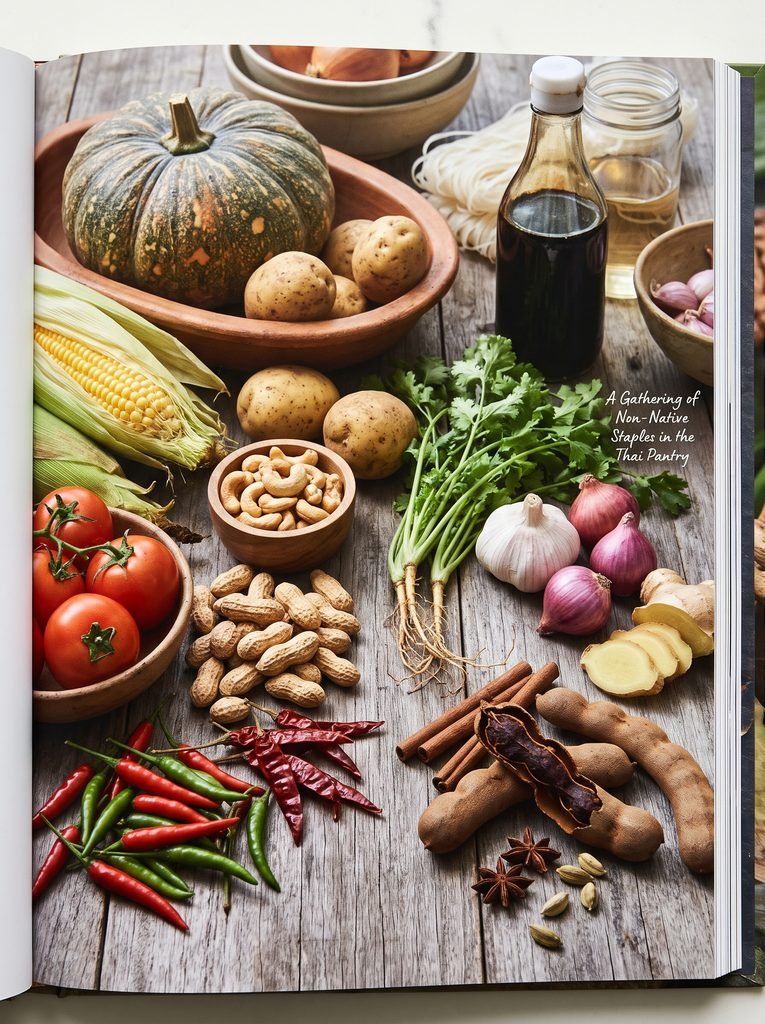
Every single one of those dishes feels unmistakably, authentically Thai. Yet if you hop into a culinary time machine and travel back just 500 years to the ancient Siamese capital of Ayutthaya, you would find zero chili peppers, zero papayas, zero peanuts, zero tomatoes, and zero potatoes anywhere in the kingdom.
One of the greatest secrets of Thai food is that Thailand has always been the ultimate culinary alchemist. Sitting right at the maritime crossroads of Southeast Asia, Siam welcomed sailors, merchants, diplomats, and travelers from around the globe. Rather than rejecting unfamiliar foreign crops, Thai cooks tasted them, tested them against local herbs and fermented sauces, and reinvented them so completely that the rest of the world now associates those ingredients with Thailand first.
Grab your passport for a gastronomical adventure tracing how some of Thai cooking’s most famous staples traveled across oceans from the Americas, Europe, and the Mediterranean to become the beating heart of Thai cuisine.
1. Chili Peppers (Prik): From Mesoamerican Jungles to Thai Fire
It is almost impossible to imagine Thai food without the bright, electric heat of the bird’s eye chili (prik kee nu). Before the 16th century, Thai cooks created warmth using native black peppercorns, wild ginger, galangal, and long pepper. Everything changed when Portuguese and Spanish explorers crossed the Atlantic and Pacific during the Columbian Exchange, carrying Capsicum seeds native to Central and South America.
When Portuguese traders arrived in the Kingdom of Ayutthaya in the 1500s, those vibrant red and green pods found an instant second home in Thailand’s tropical soil. Thai farmers quickly selectively bred dozens of distinct local varieties from tiny, explosive bird’s eye chilies to milder, fruity spur chilies (prik chee fah). In the Thai kitchen, chilies were pounded in stone mortars alongside native lemongrass, galangal, and shrimp paste, giving birth to modern green, red, and yellow curry pastes and transforming fiery heat into one of Thailand’s signature flavor pillars.
2. Green Papaya (Malakor): The Caribbean Fruit That Became Isan’s Greatest Salad
Ask any traveler to name Thailand’s ultimate street food dish, and Som Tam (spicy green papaya salad) is almost guaranteed to top the list. Yet the papaya tree originated thousands of miles away in southern Mexico and Central America.
Carried across the Pacific via Spanish galleons to the Philippines and onward through Southeast Asian trade routes, papaya thrived effortlessly in Thailand’s warm, humid climate. While Western diners treated ripe papaya strictly as a sweet breakfast fruit, creative cooks in northeastern Thailand’s Isan region discovered that unripe, crisp green papaya acted like a refreshing, neutral sponge. Shredded into fine ribbons and pounded in a wooden mortar with lime juice, fish sauce, palm sugar, tomatoes, and chilies, this Central American newcomer became the centerpiece of Thailand’s most iconic regional salad.
3. Peanuts (Thua Lisong) and Cashews (Met Mamuang Himaphan): South American Crunch Meets Thai Street Woks
Whether sprinkled over Pad Thai, blended into creamy satay dipping sauce, or tossed into tangy herb salads (yam), peanuts bring essential crunch and richness to Thai cooking. Like chilies and papaya, peanuts are native to South America, specifically the valleys of Peru and Brazil, before European maritime traders introduced them to Asian ports in the 16th century.
Alongside peanuts came another South American native, the cashew, which Portuguese sailors brought from Brazil to coastal Asia. In southern Thailand, cashews flourished so abundantly that they earned the poetic Thai name met mamuang himaphan (seeds of the mythical Himaphan forest) and became the star of beloved stir-fries like Gai Pad Met Mamuang (chicken with cashew nuts).
4. Tomatoes (Makhuea Thet): Look at the Clue Hidden in the Thai Name
Sometimes the Thai language itself preserves the travel diary of an ingredient. In Thai, a tomato is called makhuea thet, which literally translates to “foreign eggplant.”
Originally domesticated by ancient civilizations in the Andes mountains of South America, tomatoes arrived in Siam via European merchant ships during the Ayutthaya era. Thai cooks immediately recognized the tomato’s bright, juicy acidity as a natural partner for savory broths and chili pastes. Today, cherry tomatoes and plum tomatoes are indispensable for adding natural sweetness and tang to Tom Yum Goong, northern Thai pork-and-tomato chili dip (Nam Prik Ong), and every plate of Som Tam.
5. Potatoes (Man Farang) and Sweet Potatoes: The Secret Behind Massaman Curry
Just like tomatoes, the humble potato carries its foreign passport right inside its Thai name: man farang, meaning “Western tuber.” Originating in the Peruvian Andes, potatoes traveled aboard European trading vessels into Indian and Siamese ports.
Potatoes found their greatest Thai triumph inside Massaman curry, a dish born in the cosmopolitan royal kitchens of Ayutthaya where Persian, Indian, and Malay traders mingled with Siamese court chefs. By simmering chunks of tender man farang in coconut milk infused with warm roasted cardamom, cinnamon, cloves, and tamarind, Thai cooks created a comforting masterpiece that regularly ranks among the world’s most beloved dishes.
6. Cilantro (Phak Chi): From the Mediterranean to Every Thai Mortar
From the aromatic root pounded into the base of curry pastes and marinades to the delicate green leaves scattered over soups and stir-fries, cilantro (coriander) is woven into every layer of Thai cooking. Yet this fragrant herb actually traces its roots to the Mediterranean basin and the Middle East, traveling east along ancient overland Silk Road and Indian Ocean spice routes centuries ago. While many global cuisines only use the leaves or dried seeds, Thai cooks unlocked the full magic of the plant by turning cilantro root (rak phak chi), pounded with garlic and white peppercorns, into the foundational flavor trio (sam kloe) of the Thai kitchen.
7. Pineapple (Sapparot): Tropical Sweetness in Savory Curries
Sweet, tangy pineapple feels like the ultimate tropical Asian fruit, yet it originated in the borderlands of Brazil and Paraguay before Spanish and Portuguese explorers carried it across the Pacific. Thai cooks embraced pineapple not just as a refreshing fruit, but as a brilliant savory ingredient, balancing spicy red curries (Gaeng Khua Sapparot), tenderizing grilled meats, and starring inside sweet-and-sour stir-fries and baked pineapple fried rice.
The Genius of the Thai Kitchen
Tracing the global journeys of these ingredients reveals why Thai cuisine remains one of the most dynamic food cultures on earth. Thailand never treated culinary tradition as a rigid museum piece locked behind glass. Instead, Thai cooks welcomed flavors from South America, the Mediterranean, India, China, and Persia, folding each newcomer into Thailand’s signature four-part harmony of spicy, sour, sweet, and salty until every guest became family.