

In the autumn of 2023, a dry, raspy, rhythmic cadence crawled out of multiplex sound systems and paralyzed moviegoers across Southeast Asia: “Tee Yod… Tee Yod…”
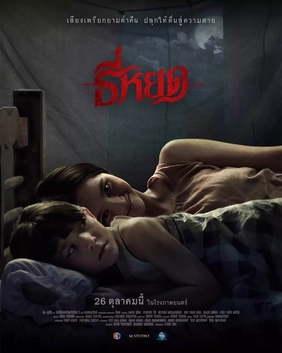
It sounded like cracked bamboo stalks dragging across a rusty corrugated tin roof. Within weeks, Taweewat Wantha’s Death Whisperer (Tee Yod), and subsequently its massive 2024 sequel, shattered domestic box-office records, becoming the first Thai features shot natively for IMAX and transforming a 2015 viral internet thread into a multi-million-dollar cinematic juggernaut.
The terror of Tee Yod cuts particularly deep within the Thai psyche because it draws upon real-life claims of ordinary Thais: the memories of a family besieged by an unseen predator in the rural borderlands of Kanchanaburi Province in 1972.
To understand why this franchise dismantled the conventions of modern supernatural cinema, one must look closely at its physical environment: the non-traditional architecture of the farm compound, the real geography of Dan Makham Tia, the animist ecology of bamboo and cursed timber, and the blood-soaked metaphysics of the Woman in Black.
The Rural Farmhouse
A frequent misconception in casual discussions of Thai horror is assuming every rural ghost story takes place inside an elevated, open-air wooden stilt house (ruan thai). Tee Yod completely breaks this visual cliché.
The farmhouse depicted in the film, faithfully reconstructed from the ground up as a dedicated set backed by the Kanchanaburi hills, is a hybrid mid-century frontier compound built directly on the ground.
The main living quarters sit on the ground rather than elevated wooden posts. The structure itself is loosely constructed, with uninsulated, weathered planking encasing the perimeter and interior walls, from the living room to the sleeping areas. The need for everyone to sleep under mosquito netting are constant visual reminders of how exposed the members of the family are to the outside world and that the notion of ‘safety’ within their home is just that, a notion.
Because the family represents a working agrarian Thai-Chinese lineage, the ground floor resembles an open, utilitarian workshop and barn garage. Vintage pickup trucks, farm tractors, grain sacks, and hand tools are parked directly on the dirt threshold outside the living room.
Without an open crawlspace underneath (tai thun), the horror is granted claustrophobic access to the family. The entity does not have to crawl under the floorboards or float through the air to access the family, it unlatches bedroom windows and scratches through walls, peers through shutter gaps, circles the wide zinc-sheet corrugated eaves, and infiltrates the house through the adjoining open-air kitchen and wash area.
The Real Frontier: 1972 Dan Makham Tia, Kanchanaburi
The setting is an indispensable character in the Tee Yod mythos. The narrative is rooted in Dan Makham Tia District, an isolated farming settlement in southern Kanchanaburi Province near the border of Ratchaburi.
In 1972, this was not a manicured tourist corridor with boutique jungle resorts. It was a raw, unforgiving frontier characterized by profound and deafening isolation.
Dirt tracks dissolved into impassable red clay during monsoon downpours. There was no municipal electrical grid, no landline telephone service, and hours of rough road separated isolated homesteads from the provincial hospital in Mueang Kanchanaburi. If someone fell violently ill at 2:00 AM, you couldn’t call an ambulance; you had to hand-crank an old diesel engine and pray the truck didn’t get high-centered while off-roading through a ditch.
Kanchanaburi has historically served as a fluid cultural corridor where Central Thai culture, Karen mountain communities, and Mon-Khmer populations converge. In the minds of local villagers, the surrounding Tenasserim Hills and deep forests harbored ancient esoteric practices (saiyasart) that sat well outside orthodox Buddhist oversight.
In 1972, families cleared vast parcels of virgin woodland to plant cash crops: sweet corn, cassava, and towering sugarcane. Moving into this untamed environment meant intruding upon long-established spirit domains (dong dip), where ancient ancestral entities had resided for generations without human disruption. When human plows turn that soil, the friction between the living and the ancient dead sparks immediately.
The Sound: The Mon-Khmer Occult Beacon
The core dread of the franchise centers on the chant: “Tee Yod… Tee Yod…”
The author, Kittisak Kittiwirayanont (Krittanont), noted that his mother and aunts described the sound as an unnatural, raspy cadence that seemed to emanate simultaneously from the sky, the fields, and the walls of the house.
Linguists and regional folklorists believe the best explanation traces these phonetics to archaic Mon or borderland Khmer sorcery mantras.
Unlike curses that require physical ingestio, such as consuming cursed food or nam man prai (corpse oil), Tee Yod functions through acoustic infection. Hearing the cadence breaches your psychic defenses (khwan).
The sound itself is predatory. It begins as a faint vibration, mimics the breathing of animals, imitates the familiar voices of relatives calling from just outside the perimeter, and gradually hardens into the signature rhythmic command that signals the host body has been marked for consumption.
Nature is Not Your Friend: Bamboo, Hardwood Canopies, and Dong Khomod
In Tee Yod, nature does not offer peace and escape like we envision it to, it actively colludes with the entity.
The isolated dirt path from the schoolhouse to the family homestead is bordered by massive groves of clumping bamboo (Bambusa bambos). In traditional Thai animist botany, bamboo is a liminal plant separating cultivated farmland from the wild spirit forest (dong phai).
The hollow nodes of dried bamboo act as natural acoustic resonators. When the wind moves through the grove, the creaking of the stalks mimics human groans, while the hollow stems bounce the disembodied “Tee Yod” chant from cane to cane, leaving travelers disoriented.
In both the real-life account and the film, the bamboo thicket is the physical anchor of the curse. When the family hacks into the root cluster, they uncover a sickening, decomposing mass of organic matter, slimy, rotten viscera resembling internal organs buried among the roots, proving the grove is being fed on biological death.
Old-growth hardwood trees such as massive sacred banyans (ton sai), Bodhi trees (ton pho), and giant wild figs are traditionally treated in Thai villages as sacred dwellings (wiman) for protective nature spirits (Nang Mai or Chao Thi).
In the Tee Yod universe, this spiritual hierarchy is warped. The Woman in Black perches among the upper boughs of these massive trees, crouching on thick branches like an apex predator looking down at the human settlement. The sacred shade of the forest canopy is stripped of its Buddhist sanctity and transformed into an elevated vantage point for demonic stalking.
The mythos expands into Dong Khomod, a cursed, mist-choked expanse of swamp and untamed forest. In Southeast Asian folklore, a khomod refers to an atmospheric phantom, a deceptive ghost light, or a feral spirit that lures travelers off the path into treacherous bogs. In Tee Yod, Dong Khomod represents the spiritual ground zero: an untamed expanse where disgraced shamans, forgotten graves, and dark entities cross over into the world of the living.
The Demonology: Phi Chud Dam
The antagonist of the franchise is Phi Chud Dam (The Ghost in Black), a demonic entity that exists on the fringes of a lethal intersection of a classic Phi Pop and dark ceremonial sorcery (saiyasart).
The demon possession progresses through four distinct, harrowing phases:
First comes the auditory breach. Initial contact is established through the low-frequency “Tee Yod” chant, specifically targeting an individual whose natural spiritual boundaries (khwan) have been depleted by acute illness or emotional grief.
Second is psychic depletion. The victim suffers from intense insomnia, nocturnal hallucinations, sleepwalking, and phantom sounds along exterior walls. The entity strategically mimics the cadences of loved ones to draw the victim outside the household threshold.
Third is the hijacking of the host body. As the host’s personality recedes, physical signs emerge: dilated pupils, a rigid smirk, sudden and unnatural muscular leverage, and an inverted diet that rejects cooked food in favor of raw offal, living poultry, and unpasteurized blood.
Fourth is internal consumption and collapse. Operating within the host body as a biological parasite, the entity consumes the host’s internal organs from the inside out. Once the physical energy is depleted, the host shell collapses into fatal internal hemorrhaging.
When Yam’s feverish state lowers her natural spiritual shields, the entity systematically hollows her out. The tragedy of Tee Yod lies in the medical deception: the family initially seeks aspirin and ice baths for what appears to be an ordinary seasonal flu, only to watch the host’s personality evaporate, replaced by a cruel, smirking entity that feasts on live livestock at midnight before destroying the girl’s organs.
The Family Under Siege: Archetypes of the 1972 Frontier
The emotional resonance of Death Whisperer hinges on the authentic, high-friction dynamic of the eight-member family compound:
Yak, the eldest brother and an ex-soldier, and played by Nadech Kugiyama, shatters the passive archetype of the helpless horror protagonist. Confronted by an ancient, predatory entity, he refuses to rely solely on temple water and monk chants. Armed with a 12-gauge shotgun, combat machetes, and military aggression, Yak transforms the film from a story of victimization into an active supernatural hunt.
Yad, played by Denise Jelilcha Kampuan, is the domestic chronicler who notices the minute shifts in Yam: the sudden drop in body temperature, the glazed stare, and the eerie, cold cadence of her voice. Based directly on the author’s real mother, her domestic perspective grounds the horror.
Yam’s physical deterioration anchors the body horror of the story. Her descent, from a radiant schoolgirl into a snarling, hollowed-out vessel, illustrates the predatory nature of the curse.
The younger brothers, Yos and Yod, shoulder the agrarian labor and form the domestic militia alongside Yak, patrolling the dark cornfields with hunting rifles.
Yee’s childlike sensitivity makes her an intuitive medium. She detects the Woman in Black lurking in high tree canopies and outside windows long before the older siblings spot her.
The parents, Hang and Boonyen, represent the post-war agrarian generation. Their reliance on traditional village elders, herbal medicine, and Buddhist prayers clashes with Yak’s tactical reality, capturing the generational divide of early-1970s Thailand.
The Subversion of Thai Folk Horror
For decades, the dominant template of rural Thai horror was either the tragic romantic gothic of Mae Nak or the comedic slapstick chases of Baan Phi Pop. Tee Yod created an entirely new subgenre: The Rural Thai Gothic Action-Horror.
By grounding its horror in slab-built frontier farmhouses, dense cash-crop monocultures, and the genuine military hardware of the 1970s, director Taweewat Wantha bypassed the nostalgic, museum-like aesthetics of period pieces. In this universe, folklore is neither quaint nor safely confined to old temple scrolls. It is a hungry, predatory force lurking in the dark bamboo, waiting for a single feverish child to step off the path—and met by a family willing to empty a shotgun straight into the shadows.