

When western audiences discuss Thai horror, conversation almost always defaults to a familiar visual shorthand: long dark hair dripping over an unblinking eye, an impossible shadow tucked inside a high-rise photograph, or a grieving monk chanting against a vengeful spirit trapped between karmic cycles. The golden era of early-2000s Bangkok cinema exported atmospheric dread better than almost anyone on the planet. Masterpieces like Banjong Pisanthanakun and Parkpoom Wongpoom’s Shutter proved that a single Polaroid snapshot could carry more existential terror than an entire warehouse of rusty meat hooks.
That celebrated reputation, however, paints an incomplete picture of what Thai genre filmmakers were actually cooking up in the mid-to-late 2000s. Running parallel to quiet Buddhist morality tales was an alternate movement: wild, hyper-violent, pitch-black shock cinema that shoved ghost stories into oncoming traffic and replaced subtle atmospheric dread with industrial bone saws, cursed needles, and boiling cooking oil.
These films did not arrive by accident. They emerged during a period of fierce regional competition, where local studios realized that international buyers at film markets were hungry for extreme sensations. Hong Kong had its Category III extremity, Japan had Takashi Miike and the burgeoning torture-tinged cyberpunk movement, and France was kicking off its New French Extremity. Thailand responded by weaponizing its own cultural textures—animist curses, rural isolation, hyper-modern urban rot, and street-level black comedy—producing works of staggering, unapologetic butchery. For viewers convinced Thai horror begins and ends with atmospheric chills, these five films offer a chaotic, adrenaline-charged reality check.
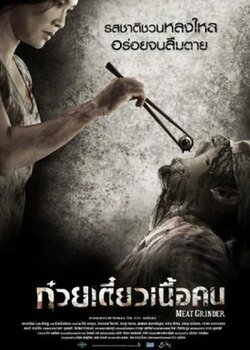
1. Meat Grinder (Chueat Kon Chim, 2009)
If there is a patron saint of pure, unadulterated Thai culinary carnage, it belongs entirely to Tiwa Moeithaisong’s Meat Grinder. The film entered production with the explicit mission to push visual boundary-pushing as far as national censors would allow, and the result remains one of the most grueling sensory assaults in Southeast Asian cinema.
The plot follows Buss, portrayed with ferocious commitment by pop star and dramatic actress Mai Charoenpura. Buss is a poverty-stricken street cart vendor trying to keep her noodle stall afloat while buried under predatory debts, haunted by memories of an abusive childhood, and struggling to care for her ailing young daughter. When a violent street riot leaves a dead protester hidden inside her mobile cart, Buss makes a frantic, desperate calculation: discard the evidence, slice up the fresh meat, season the broth with lemongrass and fish sauce, and serve it to the neighborhood.
The immediate twist is that her customers love the recipe. The noodle stall transforms into an overnight sensation, forcing Buss into a vicious feedback loop where maintaining her livelihood requires an endless supply of fresh human flesh.
Where lesser directors would lean entirely into cheap camp, Moeithaisong constructs Meat Grinder with a gritty, grime-caked visual palette. The audio design alone tests the stomach, filled with wet crunches, heavy cleaver impacts on wet cutting boards, and the dull ring of rusty nails driven into bone. Buss does not merely dispatch victims; she preserves them in basement vats, nails limbs to floorboards to prevent escape, and strips muscle with the quiet methodical precision of a butcher preparing morning stock.
Beneath the gallons of gore lies a genuinely harrowing portrait of systemic destitution and inherited trauma. Buss is not an immortal supernatural killer, but an utterly broken woman unraveling in a city that offers no safety net. The film faced severe pushback from domestic regulatory bodies upon release—leading to trims and alternative cuts—yet its reputation as an unhinged, blood-drenched classic remains entirely intact.
2. Art of the Devil 2 (Long Khong, 2005)
Few films captured the global imagination of mid-2000s shock hounds quite like Long Khong, better known to overseas video store clerks and festival circuits as Art of the Devil 2. Directed by the Ronin Team—a creative collective of seven filmmakers who traded traditional directorial restraint for maximalist mayhem—the movie completely severed ties with the tame, procedural tone of its 2004 predecessor.
The story starts innocently enough with classic slasher scaffolding. A group of six former high school classmates reunite years after graduation, journeying to a remote rural village to visit the family home of their friend Ta. Lingering beneath their nostalgic smiles is a shared, ugly secret: years earlier, they played a cruel, sexually humiliating prank on Ta’s stepmother, a seductive teacher named Panor (played with terrifying elegance by Napakpapha Nakprasitte). What the former students do not realize is that Panor has spent the intervening years immersing herself in the darkest corners of saiyasat—ancient animist black magic.
Once the group is isolated inside the compound, the film abandons conventional suspense in favor of a sustained, agonizing chamber of horrors. The Ronin Team took every localized folklore superstition about curses and translated them into physical, anatomical torture. The kills here are legendary among genre purists for their sheer cruelty and innovative practical effects.
In one of the film’s most famous sequences, a victim is pinned down while an enraged Panor pours boiling oil over his flesh before prying skin away to break a ritual ward. In another, black magic forces thousands of metal fishing hooks to manifest beneath a character’s dermis, requiring them to be physically yanked out through torn muscle tissue while the victim is still breathing.
Unlike Western slashers where masked killers chase teenagers through woods with machetes, Long Khong turns the human body into an active biological prison. It trades western jump scares for relentless, excruciating body horror, cementing Panor as one of the most ruthless antiheroines in modern horror cinema.
3. Sick Nurses (Suay Laak Sai, 2007)
Every list of splatter cinema needs a wild card, and Sick Nurses sits in a category entirely of its own creation. Directed by Piraphan Laoyont and Thatsana Seemanut, this film feels less like a traditional horror release and more like an ultra-saturated, candy-coated nightmare directed by a punk rock stylist who raided a surgical supply depot.
Set within the clinical, sterile confines of a private Bangkok hospital, the narrative centers on an operating room squad led by a handsome doctor and a clique of glamorous nurses. Beneath their pristine uniforms, the group runs a lucrative black-market side hustle: harvesting organs from deceased patients and selling them to elite buyers. When one nurse, Tahwan, threatens to blow the whistle after discovering her lover—the doctor—is cheating on her, the rest of the crew conspire to murder her, bundling her corpse into a trunk and shipping it off to their brokers.
Seven days later, Tahwan returns. What follows is a kaleidoscope of high-fashion revenge cinema. Rather than appearing as a pale, dripping ghost crawling across ceiling tiles, Tahwan’s spirit exacts vengeance through tailor-made, hyper-stylized surgical assassinations that mirror each nurse’s vanity and deadly sins.
The set pieces are spectacular in their cruelty and absurd visual wit. Victims are wrapped head-to-toe in medical tape until their skulls implode, force-fed deadly surgical implements, sliced apart with high-tension sutures, and dismembered with laser-focused hospital gear.
The color palette pops with bubblegum pinks, clinical whites, and blinding crimson fountains, creating an intentional contrast between soap-opera melodrama and jaw-dropping splatter. Sick Nurses never takes itself too seriously, yet the sheer inventiveness of its practical kills and manic pacing make it an indispensable time capsule of Thailand’s mid-2000s boundary-pushing output.
4. Scared (Khao Chon Kai, 2005)
When western slashers hit a formulaic dead end in the early 2000s, Thai director Pakphum Wonjinda decided to demonstrate how much momentum could be extracted from stripping the genre down to pure kinetic carnage. Scared (released domestically under the title Tarot) takes the high-school-trip-gone-wrong trope and accelerates it into an unyielding gauntlet of mechanical slaughter.
The setup is classic: a busload of rowdy first-year university students heads off into the deep jungle for an initiation retreat. Before they even reach their destination, a rickety suspension bridge collapses, cutting them off from civilization. Stranded on an abandoned, overgrown military training facility, the students realize they have stumbled into a deadly proving ground where hidden cameras track their every move and lethal booby traps wait behind every bush.
What separates Scared from run-of-the-mill wilderness slashers is its breathless pacing and sheer mean-spirited velocity. The film operates like a cross between Final Destination and an unapologetic Italian cannibal movie minus the jungle tribes. The traps are brutal, sudden, and engineered to wipe out characters mid-sentence.
Characters are halved by runaway industrial log carriers, impaled on high-velocity bamboo spikes, decapitated by hidden tripwires, and shredded by vintage munitions. Wonjinda demonstrates a gleeful disregard for standard narrative armor; characters who appear positioned as traditional final survivors are unceremoniously pulverized minutes into the second act. The practical effects favor high-pressure blood squirts and torn prosthetics over digital polish, lending the entire production a raw, sweaty, grindhouse energy that rarely lets the audience catch its breath.
5. 13 Beloved (13: Game of Death, 2006)
While 13 Beloved leans into the structural architecture of a psychological thriller, its descent into Grand Guignol splatter earns it a permanent seat at the table of unhinged Thai cinema. Directed by Chookiat Sakveerakul and adapted from his own underground comic strip, the film trades rural jungles and haunted operating rooms for the cold, uncaring concrete of modern Bangkok.
The story follows Phuchit (played with tragic vulnerability by Krissada Sukosol Clapp), an introverted, down-on-his-luck musical instrument salesman. In the span of a single morning, Phuchit loses his job, discovers his bank account is overdrawn, gets dumped by his partner, and watches his car get repossessed. Enter an anonymous phone call offering him an escape: participate in a real-time reality game show consisting of thirteen sequential challenges. Complete every task, and a tax-free fortune of one hundred million baht hits his account. Fail or quit, and he forfeits everything.
The opening tasks begin as cruel, degrading social pranks—swatting a fly with a rolled-up newspaper, eating the fly, making children cry. But as the prize pool swells, the challenges escalate into harrowing physical and psychological violence.
Before the runtime wraps, Phuchit is navigating a pitch-black labyrinth of human cruelty. The splatter here hits with visceral impact because every drop of blood represents an active moral compromise by the protagonist. The infamous sequence involving a high-tension clothesline across a dark street—engineered to decapitate speeding motorcyclists—remains one of the most shocking sequences in contemporary Asian action-thriller history.
From retrieving a corpse from the bottom of an abandoned septic well to butcher-shop confrontations that leave rooms painted in crimson, 13 Beloved is a relentless exploration of human greed weaponized through practical gore. It proved that a slasher does not need a masked ghoul with a knife; sometimes, an ordinary man carrying a smartphone and a mountain of unpaid bills is more dangerous than any monster.
