

This is a re-publication of our original article released prior to the God Skin global release.
Stepping outside the safe perimeter of a country’s cinematic brand is a terrifying gamble. For twenty-five years, international distributors have known exactly how to sell Thai cinema to foreign buyers: you either hand them the visceral, bone-snapping Muay Thai choreography of Tony Jaa, or you turn the lights out and let an animist spirit rattle the floorboards. Step into those established sandboxes, and the checks clear; step out, and you risk tumbling into the uncanny valley of mid-budget genre cinema, where local audiences accuse you of being pretentious and global programmers dismiss you as a derivative copy of Hollywood.
Sitting down across from the creative brain trust behind God Skin (หมัดเทวา ท้าเดิมพัน), you realize immediately that nobody in this room was interested in playing defense.
Conducted during their festival run at Montreal’s prestigious Fantasia International Film Festival, the historical launchpad where genre cinema either earns its cult stripes or gets eaten alive, our roundtable sit-down with director Paween “Golf” Purijitpanya, producer Surawut “Noom” Tungakararak, MIT scientist-writer Pat Pataranutaporn, and star Gee Sutthirak Subvijitra felt less like a standard promotional junket and more like an urgent post-mortem on an industrial breakthrough.
Golf has spent two decades proving he is one of Southeast Asia’s most restless visual stylists, jumping from the kinetic folk-horror of the Phobia franchise to the sterile, high-concept medical halls of Netflix’s Ghost Lab. But with God Skin, he pushed the envelope into unapologetic cyberpunk folklore. The linchpin of the film’s conceptual engine is Sak Yant—the sacred, centuries-old animist tradition of tattooing protective geometric script onto flesh.
Where conventional cinema treats the ink as mystical hocus-pocus requiring temple chants and incense bowls, Pat Pataranutaporn’s background at the MIT Media Lab rewired the entire spiritual apparatus. Having previously teamed up with Golf on Netflix’s Tomorrow and I, Pat treated the skin not as an altar, but as a biological motherboard. In the world of God Skin, the sacred tiger and ancient geometric wards are re-engineered as programmable sub-dermal nanotech: microscopic machines swimming through the bloodstream, hardening bone density, accelerating adrenaline uptake, and deadening pain receptors on command.
It is an audacious, brilliant modernization of folk belief. Centuries ago, warriors etched ink into their skin because they believed divine spirits would turn away enemy blades; in a near-future Bangkok dictated by hyper-capitalist bio-engineering, desperate men inject programmable hardware into their veins for the exact same reason. By rooting the high-tech mechanics in authentic Muay Thai geometry, the film skips the plastic, neon-tinted clichés of Western sci-fi and plants its feet firmly in the red dirt of home.
Yet the film’s pulse doesn’t come from computer-generated nanobots; it comes from raw, working-class economic terror.
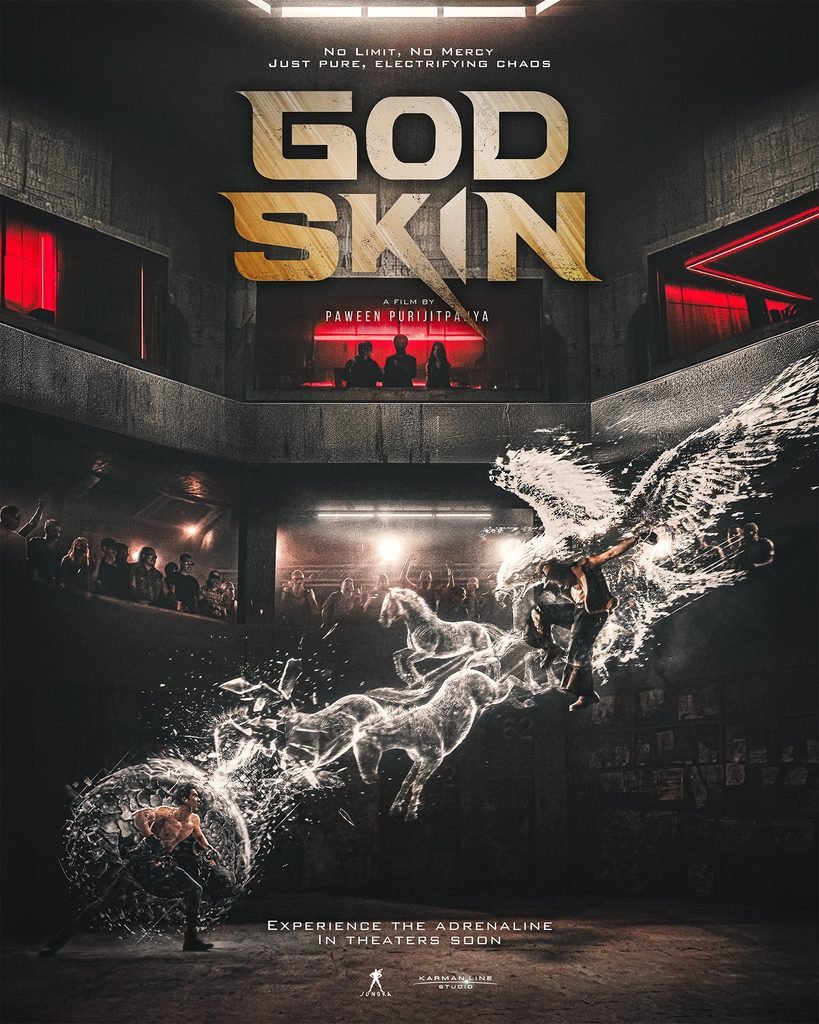
The story anchors on Win, an everyday delivery rider whose bank account has flatlined, pushing him into “Mirage” a brutal, subterranean combat circuit where Bangkok’s wealthy elite wager fortunes on destitute fighters trading nanotech-enhanced punches.
Golf didn’t mince words about the social anatomy of the set: this underground blood sport isn’t a dystopian fantasy, it is an unsparing mirror of modern Thailand’s household debt crisis. It is the story of an urban underclass systematically ground down by stagnant wages, forced to treat their own physical organs and bodily safety as collateral just to keep their families fed. Behind the neon flares and skull-cracking impacts, the stakes remain painfully human.
Bringing that physical punishment to life required Gee Sutthirak to dismantle the easy, telegenic charm that made him a household name in 4 Kings II and My Boo.
For an entire year, Gee lived on an agonizingly strict regimen of steamed egg whites and boiled pumpkin, stripping away body fat and building the lean, wiry, battle-hardened musculature of an authentic ring fighter. On set, the schedule offered zero mercy. Gee was routinely expected to deliver emotionally exhausting, tear-stained dramatic beats in the morning, only to spend the afternoon executing eight-hour, full-contact combat choreography that left his knuckles bruised and his shins swollen. He didn’t hide behind digital doubles; he took the hits on the concrete.
Behind the lens, producer Surawut Tungakararak had to execute an equally precarious balancing act. Coming off the narrative precision of Girl From Nowhere, Surawut knew that shooting ambitious science fiction on a Southeast Asian budget can easily devolve into visual disaster if a production burns through its cash in post-production. The team bypassed that trap through obsessive pre-visualization, locking down every digital composite, stunt wire rig, and practical lighting setup months before principal photography ever touched a soundstage. The result is a film that looks three times its actual budget, slick, textured, and visually cohesive.
Landing God Skin at Fantasia wasn’t just a festival feather in the cap. It was an unmistakable declaration of intent: Thai filmmakers no longer have to choose between honoring their cultural heritage and commanding the global sci-fi stage. By fusing sacred ink, laboratory code, and working-class rage, Golf Purijitpanya and Gee Sutthirak didn’t just step outside the sandbox—they built an entirely new arena.