

If you walk down almost any city block in New York, Chicago, or Boston and glance at the brass water pipes mounted outside an older building, you will spot a Y-shaped metal fitting labeled a “Siamese connection.” Firefighters use it to merge two water hoses into a single high-pressure stream. Engineers use “Siamese” twin-wall tubing and dual-cylinder engines, while everyday English speakers still use the phrase “Siamese twins” whenever two things are inseparably linked.
Have you ever stopped to wonder how the historical name of Thailand (formerly known as Siam) ended up baked into American fire-department hardware and everyday English vocabulary?
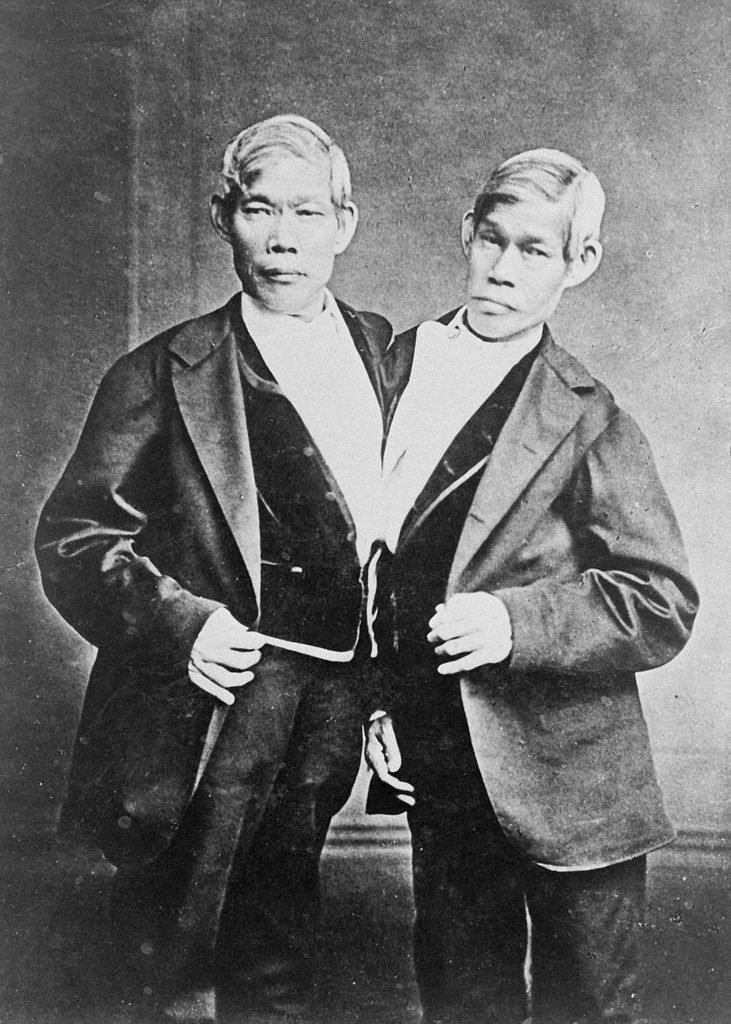
The answer belongs to Chang and Eng Bunker, two fiercely independent, razor-witted brothers born on a wooden houseboat in Samut Songkhram in 1811. Long before K-Pop idols, luxury fashion ambassadors, or international film stars carried Thai culture overseas, Chang and Eng crossed the Pacific, charmed heads of state, outmaneuvered the greediest promoters in 19th-century showbiz, and accidentally turned their homeland’s name into an English adjective that has lasted nearly two centuries.
Growing Up Aquatic in Samut Songkhram
Chang and Eng were born in May 1811 in the Mae Klong River delta, southwest of Bangkok, joined at the sternum by a short band of cartilage. In an era when medical textbooks barely knew what to make of conjoined twins, their mother treated them with total common sense. She refused to let anyone hide them away or treat them as fragile.
Instead, Chang and Eng grew up swimming like otters in the Mae Klong River, rowing boats in perfect synchronization, and raising ducks and selling preserved eggs to support their family after their father passed away. By the time they reached their late teens, they had developed extraordinary core strength, effortless coordination, and a dry, deadpan sense of humor that caught the attention of both King Rama III’s royal court and passing foreign merchants.
Sailing to America and Firing the Bosses
In 1829, a Scottish merchant named Robert Hunter and an American sea captain named Abel Coffin convinced the brothers’ mother to let eighteen-year-old Chang and Eng tour the United States and Europe. The promoters figured they had discovered a goldmine and promptly put the teenagers on stage under the billing “The Siamese Double Boys.” Hunter and Coffin made one fatal mistake: they assumed two young men from a river village in Siam would be easy to push around.
Chang and Eng quickly taught themselves fluent English, studied American business contracts, and realized their promoters were pocketing almost all the ticket money while paying the brothers peanuts. The moment Chang and Eng turned twenty-one in 1832, they walked out on their managers, took control of their own touring schedule, hired their own advance agents, and kept 100 percent of the profits for themselves. Overnight, they transformed from exploited curiosities into two of the savviest self-managed entertainers in the 19th century.
Master Showmen With Deadpan Wit
On stage across America and Europe, Chang and Eng refused to act like passive exhibits. They turned their performances into interactive variety shows featuring acrobatics, synchronized badminton matches, sharp political banter, and Q&A sessions where they routinely outwitted smug hecklers.
When a nosy audience member in London once asked whether one brother felt pain if the other was pinched, Chang reportedly replied with complete seriousness that they only felt pain when someone wasted their time asking foolish questions. Audiences loved their confidence, charm, and impeccable manners. Even famous showman P.T. Barnum occasionally worked with them later in life, though Barnum admitted the Bunker brothers drove a harder bargain than almost anyone else in the entertainment business.
Southern Gentlemen, Naturalized Citizens, and 21 Kids
By 1839, Chang and Eng had earned enough wealth to retire from nonstop touring. They bought fertile farmland in Mount Airy, North Carolina, became naturalized United States citizens, and adopted the surname Bunker (reportedly inspired by a friendly New Yorker they met during their travels).
Then came their greatest plot twist. In April 1843, Chang and Eng married two local sisters, Adelaide and Sarah Anne Yates, in a double wedding that fascinated the entire country. Settling into two separate farmhouses a mile and a half apart, the brothers established a strict house rule: three days at Chang’s house where Chang made all decisions, followed by three days at Eng’s house where Eng was in charge. Between the two households, they raised an astonishing 21 children, many of whom went on to become respected farmers, teachers, and civic leaders in North Carolina.
How “Siamese” Entered the American Dictionary
Because Chang and Eng were the most famous people from Thailand that 19th-century Americans had ever seen, newspapers constantly referred to them simply as “the Siamese Twins.” Their fame was so colossal that the word “Siamese” detached itself from geography and took on a brand-new life in American English as shorthand for any two identical things joined together.
That linguistic legacy still surrounds Americans every single day:
- Firefighting Gear: When late-19th-century engineers invented a Y-shaped brass fitting allowing firefighters to combine two hose lines into one master stream (or split one line into two), they immediately named it a Siamese connection, a term still printed on building exteriors and firefighting manuals across North America today.
- Engineering and Mechanics: Industrial designers still use Siamese cylinders, Siamese pipes, and Siamese cables to describe paired components cast or fused side by side.
- Everyday Speech: Even long after Thailand officially changed its international name from Siam in 1939, English speakers kept using “Siamese” as a playful metaphor for inseparable best friends, twin ideas, and matching objects.
Chang and Eng Bunker lived until January 1874, passing away within hours of each other at age sixty-two. Looking back nearly two hundred years later, their story reads like a joyful triumph of Thai resilience and humor. Starting from a wooden houseboat on the Mae Klong River, two brothers turned curiosity into respect, built an American legacy on their own terms, and left a piece of Thailand permanently welded onto city streets across the English-speaking world.