

If you step inside a crowded Bangkok concert hall on the night Lomosonic takes the stage, you will witness one of the most intense live spectacles in Asian rock music. Seconds into the set, lead vocalist Boy (Ariyathat Phontal) is gripping the microphone with both hands, veins straining in his neck as he screams raw, heartbreaking lyrics over roaring post-hardcore guitars before launching himself headfirst into a sea of raised hands.
Now picture that exact same man stepping onto the set of acclaimed director Kongkiat Khomsiri’s gritty crime-thriller Prasert, trade the stadium spotlights for shadowy backstreets, dial the volume down to a whisper, and watch him inhabit Sak Bo Phloi, a rising, cold-nerved hitman armed with a long rifle and a stare that freezes everyone in the frame.
For international fans exploring modern Thai entertainment, Boy Lomosonic represents one of the most compelling dualities in pop culture today. Offstage, he speaks with the calm, respectful cadence of a thoughtful artist; onstage, he is Thailand’s screaming poet of emotional release; and on the big screen, he proves that real intensity can be just as terrifying in silence as it is at a hundred decibels.
The Quiet Artist Who Built Thailand’s Loudest Emotional Lifeline
Long before he became an arena headliner or movie actor, Boy’s artistic instincts were shaped through visual art and Bangkok’s fiercely independent underground music scene. Founded in 2005 with bandmates Pom (guitar), Piti (guitar), and Otto (drums), Lomosonic debuted in 2009 on the beloved indie label Smallroom before eventually rising to major festival stages under Genie Records.
In a traditional Thai social culture that prizes keeping a “cool heart” (jai yen), smiling through hardship, and maintaining polite restraint (kreng jai) in public, Lomosonic’s music arrived like an open window in a crowded room. Boy did not write songs about surface-level party fun, he wrote deeply poetic, unfiltered confessions about heartbreak, regret, grief, and survival.
When Lomosonic released “Khor” (Warm Eyes) in 2014 alongside emotional anthems like “Kwam Roo Suek Khong Wan Nee” (Felt) and “Song Ther Dai Tao Nee” (Goodbye), something remarkable happened. Hundreds of millions of listeners turned those songs into shared emotional lifelines. At live concerts, Boy turned crowd-surfing and mosh pits into something distinctly Thai: a warm, protective brotherhood where strangers catch one another, scream out the pain they carry through work and school, and walk home feeling lighter.
Stepping Into the Shadows: Hitman Sak Bo Phloi in Prasert
In late 2026, Boy surprised even his most devoted rock fans by taking on his first full-length feature film acting role in Prasert (releasing in Thai cinemas November 26, 2026), directed by Khom-Kongkiat Khomsiri, one of Thailand’s premier masters of gritty action and dark human drama.
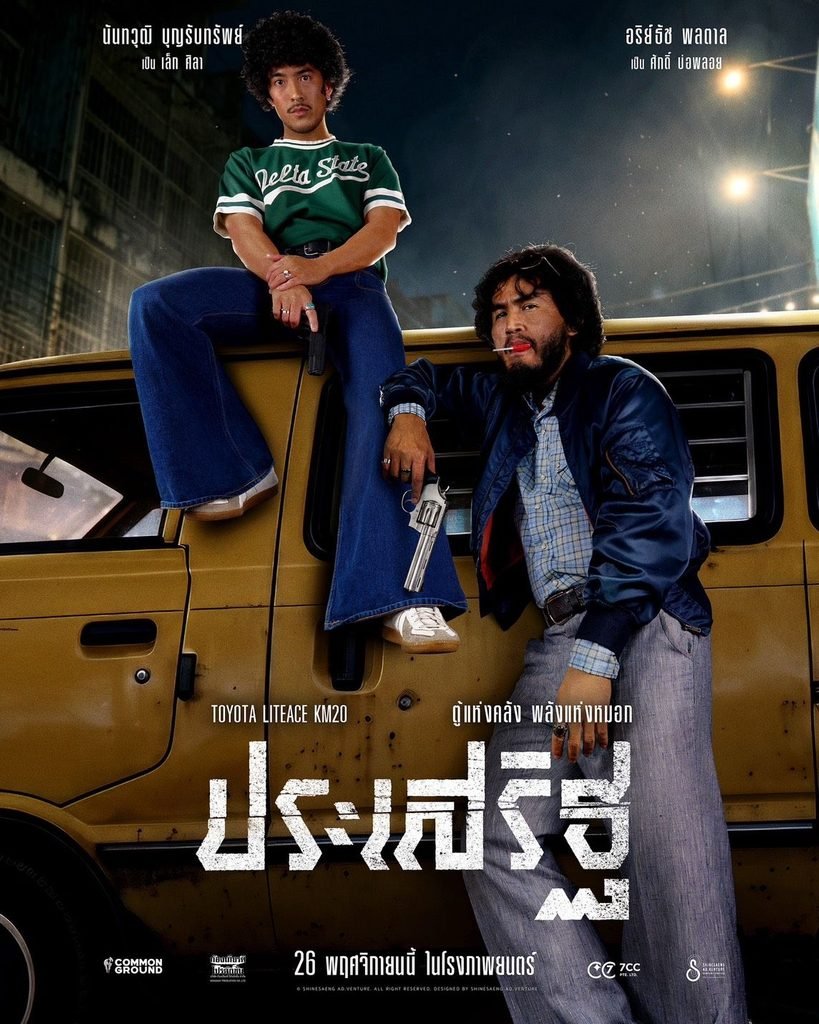
Sharing the screen with heavyweight Thai stars Noom Kanchai Kamnerdploy (playing Prasert, a car-rental owner pulled into the criminal underworld), Weir Sukollawat Kanarot (Dong Ratchawat), and Two Popetorn Soonthornyanakij (Banjop Nokdab), Boy steps into the shoes of Sak Bo Phloi, a direct, blunt, long-gun-wielding enforcer inside a tight-knit gang of hitmen bound together like family.
As Boy shared in interviews leading up to the premiere, playing a professional killer could not be further removed from his real-life personality. Yet that very contrast is what makes his performance magnetic. Behind Sak Bo Phloi’s brash, straightforward exterior lies hidden emotional complexity—and Boy brings the exact same fearless commitment to camera work that he brings to a festival stage. Instead of leaning on rock-star swagger, he strips away every familiar mannerism, letting stillness, heavy silence, and coiled physical tension do the talking.
Why Thailand Celebrates Artists Who Break Their Own Mold
For foreign readers getting to know Thailand’s creative landscape, Boy Lomosonic’s leap from post-hardcore frontman to big-screen hitman highlights something wonderful about Thai entertainment. Rather than locking musicians into narrow boxes, Thai audiences and directors actively celebrate artists who treat creativity as a lifelong challenge—calling a bold new role an earned medal rather than a safe victory lap.
Whether Boy is standing at the edge of a festival stage with ten thousand voices singing every word of “Khor” back at him, or holding a long rifle in the tense quiet of Prasert, his gift remains the same: he never holds anything back, and once he steps into the spotlight, it is impossible to look away.