

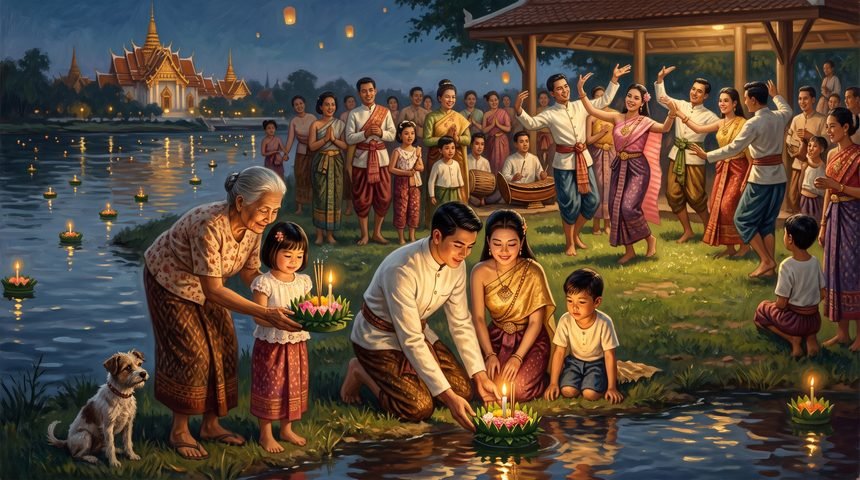
If you imagine a sacred spiritual ceremony by the water, you probably picture quiet meditation, hushed whispers, and solemn reflection. Step down to a Bangkok riverside pier, a Chiang Mai canal, or a neighborhood temple pond on the full-moon night of Loy Krathong, however, and you are greeted by one of Thailand’s most wonderful contradictions: thousands of glowing candles drifting peacefully down the dark water while loudspeakers blast the happiest, most infectious folk-pop songs in the country.
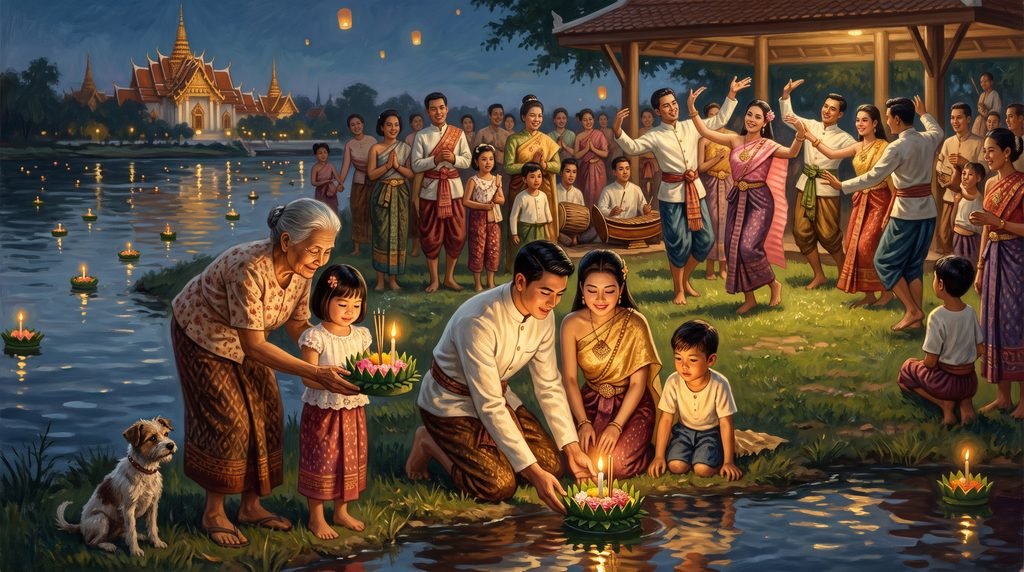
Held annually on the evening of the full moon of the twelfth month in the traditional Thai lunar calendar (usually falling in November), Loy Krathong is often called Thailand’s “Festival of Lights.” Yet for Thai people, the night is far more than a pretty photo opportunity. It is a deeply meaningful ritual of gratitude, renewal, and shared community joy (sanuk), accompanied by a musical soundtrack that every child in Thailand learns before they even start elementary school.
Gratitude, Letting Go, and the Water Goddess
The name Loy Krathong literally translates to “floating a basket” (loy means to float, and krathong refers to a small, lotus-shaped vessel). Traditionally crafted from a cross-section slice of a banana tree trunk and decorated with folded banana leaves, fresh marigolds or orchids, three incense sticks, and a single candle, each krathong carries a heartfelt wish onto the water.
At its spiritual core, Loy Krathong is an act of thanks and apology to Phra Mae Khongkha, the ancient goddess of water. Across centuries of Thai agricultural life, rivers and canals provided drinking water, fertile rice fields, and daily transportation. On Loy Krathong night, people gather by the water to thank the goddess for sustaining life all year long and to respectfully ask forgiveness for polluting or taking the waterways for granted.
At the exact same moment, floating a krathong symbolizes letting go of negativity. Many people tuck a tiny fingernail clipping, a single strand of hair, or a small coin inside their basket, praying that past anger, bad luck, grudges, and misfortune will drift away down the current, leaving behind a clean slate and bright good fortune for the year ahead. In northern Thailand, particularly in Chiang Mai, Loy Krathong coincides with the Yi Peng lantern festival, where glowing paper lanterns (khom loi) rise into the night sky alongside the candles floating on the Ping River.
Modern Eco-Friendly Traditions and Temple Fair Magic
Over the past decade, Thailand’s love for Loy Krathong has evolved with a strong environmental conscience. Today, cities and families actively avoid Styrofoam or plastic baskets, choosing 100 percent biodegradable krathongs made from natural banana trunks, woven coconut shells, lotus petals, or even baked bread and ice-cream cones that fish in the river can safely eat the next morning. Many couples and families also share a single krathong together to reduce waste while doubling their shared wish.
Away from the water’s edge, every neighborhood temple (wat) and riverside park transforms into a lively carnival (ngan wat), complete with traditional ramwong circle dancing, classical Thai music, local artisan markets, and Nang Noppamas beauty pageants honoring the legendary Sukhothai court lady credited with crafting the first lotus-shaped krathong.
The Joyful Soundtrack: Most Popular Loy Krathong Songs
You cannot experience Loy Krathong without hearing its unmistakable music. Unlike holiday playlists in Western countries that feature dozens of competing pop hits, Loy Krathong revolves around a handful of beloved classics that instantly put a smile on every Thai face:
- “Ramwong Loy Krathong” (รำวงวันลอยกระทง): The Undisputed Anthem: If Thailand had an official national song for November, this would be it. Composed in 1955 by Maestro Eua Sunthornsanan (founder of the legendary Suntaraporn band) with lyrics by Kaew Atchariyakul, this upbeat, bouncy traditional circle-dance song opens with the famous line “Wan phen duean sib song…” (“On the full moon of the twelfth month…”). Its cheerful rhythm invites strangers, grandparents, and children to step into a circle and dance with graceful hand movements. Even an English-translated version of the song is taught in Thai schools, making it famous among expats and travelers alike.
- “Loy Krathong Disco” (ลอยกระทงดิสโก้): The Retro Party Favorite: During Thailand’s vibrant 1980s pop era, classic ramwong melodies got a funky synth-and-disco makeover, and “Loy Krathong Disco” became an instant festival staple. Whenever a temple fair or riverside stage wants to get the crowd clapping, dancing, and laughing after sunset, this upbeat retro remix is guaranteed to play.
- “Khor Moon Loy Krathong” / Modern T-Pop & Luk Thung Remixes: Every November, contemporary Thai pop stars, luk thung (Thai country) singers, and TikTok creators release fresh, high-energy versions of the classic Loy Krathong melody blending traditional ranat wooden xylophones and ching finger cymbals with modern hip-hop and electronic beats so younger generations can celebrate tradition in their own style.
- “Sukhothai Loy Krathong” & Regional Folk Ballads: In historic towns like Sukhothai, widely celebrated as the birthplace of the festival, and across northern Lanna communities, softer, poetic folk songs celebrate moonlight reflecting off ancient temple ruins, lotus blossoms, and romantic promises made beside the river.
A Night Where Light and Joy Meet
What makes Loy Krathong unforgettable for visitors and locals alike is how effortlessly it balances reverence with pure happiness. You kneel quietly at the water’s edge, light your candle, whisper a sincere thank-you for the year behind you, and watch your tiny flame join thousands of others shimmering across the dark river and two minutes later, you are smiling along to a joyful ramwong beat echoing through the warm night air. It is Thailand at its very best: deeply spiritual, warmly welcoming, and always ready to celebrate life together.