
If you watch Rodtang Jitmuangnon walk toward the ring under the blinding lights of a packed international stadium, you might think you are looking at a man born for the spotlight. His shoulders are relaxed, a wide, mischievous grin stretches across his face, and his eyes lock onto the ropes with the calm confidence of a fighter who has logged more than 325 professional bouts before turning thirty.
Yet to understand why Rodtang but known around the world as “The Iron Man” never steps backward when punches start flying, you have to travel roughly 850 kilometers south of Bangkok to a quiet, rural district called Pa Phayom in Phatthalung province.
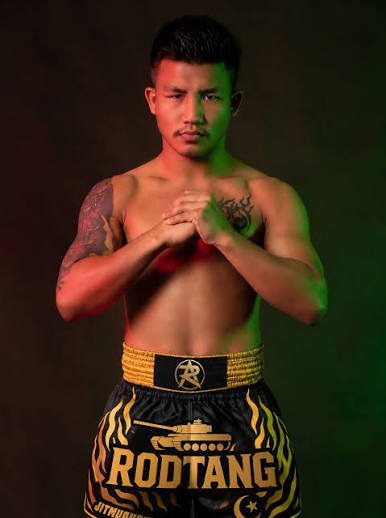
In Western combat sports, fighters often talk about chasing personal glory, championship belts, or legacy. In Thailand, Muay Thai has always been woven into a much older, deeper cultural thread: katanyu, the sacred sense of gratitude, devotion, and responsibility children feel toward the parents who raised them. Long before Rodtang became a global millionaire, a viral social media sensation, and the face of modern Thai martial arts, he was a skinny kid from a rubber-tapping community fighting simply to keep his family afloat.
Fighting for 300 Baht and Family Survival
Born Tinnakorn Srisawat on July 23, 1997, Rodtang grew up in a household where money was scarce and mouths to feed were plenty. He was the eighth of ten children, raised in a working-class southern Thai family where everyone pitched in to survive. Like countless boys across rural Thailand, young Tinnakorn discovered Muay Thai not in a gleaming fitness club, but at local temple fairs and village festivals. He started training when he was just seven years old, and at age eight, he stepped into a makeshift ring for his very first official bout. His purse that night was 300 baht, less than ten U.S. dollars.
For an eight-year-old kid in Phatthalung, 300 baht was a fortune. He handed his earnings straight to his mother to help cover household expenses, and from that moment on, Muay Thai stopped being a childhood pastime and became his family’s lifeline. Every bruise he absorbed and every kick he threw carried a clear purpose: making sure his parents and siblings had enough to live on.
Leaving Home for Bangkok and Becoming “Rodtang”
By the time he reached 14, Tinnakorn had outgrown the small provincial circuits of southern Thailand. If he wanted to earn serious money in Muay Thai, there was only one destination: the unforgiving stadium scene of Bangkok and its surrounding provinces.
He packed his bags and moved north to Nonthaburi, just outside the capital, joining Jitmuangnon Gym—a respected camp known for producing relentless, iron-willed fighters. In traditional Thai boxing culture, a fighter takes the name of their gym as their surname, symbolizing that the camp has become their second family. It was there that Tinnakorn officially became Rodtang Jitmuangnon, adopting the ring name Rodtang, which literally means “The Tank” in Thai, for his uncanny ability to march forward through heavy fire without flinching.
Living at the gym as a teenager meant waking before dawn for grueling roadwork, drilling hundreds of kicks and knees in humid afternoon heat, and sleeping beside teammates far away from home. Still, the hard work paid off. Fighting out of Bangkok’s prestigious Omnoi Stadium, Rodtang captured the 130-pound championship title and defended it twice, establishing himself as one of the toughest young standouts in Thailand’s traditional five-round circuit.
Conquering the World Stage With a Smile
In 2018, Rodtang signed with ONE Championship, stepping into a fast-paced, four-ounce-glove format that traded the slow, tactical opening rounds of traditional Bangkok stadiums for explosive action from the opening bell. It fit his forward-marching style like a tailored glove.
Less than a year later, in August 2019, Rodtang dethroned British standout Jonathan Haggerty in Manila to capture the ONE Flyweight Muay Thai World Championship. Over the next five years, he tore through the world’s elite strikers with an astonishing 14-0 run in ONE’s striking divisions, defending his gold in brutal, unforgettable wars against Haggerty, Walter Goncalves, Joseph Lasiri, and Edgar Tabares, and even testing himself in a historic mixed-rules superfight against MMA legend Demetrious Johnson.
What turned Rodtang from a champion into a global cultural phenomenon, however, was his unmistakable Thai spirit inside the cage. While opponents tried to intimidate him, Rodtang brought sanuk, the deeply Thai ethos of finding wholehearted joy and playfulness even in extreme pressure, straight into the fire. He would grin after taking a clean hook, tap his own chin to invite another shot, dance to the traditional sarama fight music between exchanges, and then drop to his knees to bow respectfully to his opponent the second the final bell sounded. With that success, he finally fulfilled his childhood promise: buying his parents a home in southern Thailand and lifting his entire family out of poverty.
Facing Stumbles, Criticism, and Redemption
Even heroes face seasons when the wheels wobble, and Rodtang’s journey has never been a smooth, sanitized fairy tale. As his fame skyrocketed across Thailand and abroad, the constant grind of weight cutting and non-stop media obligations began taking a toll. In November 2024, ahead of a scheduled title defense against Jacob Smith, Rodtang missed hydration and weight on the scales, costing him his beloved ONE Flyweight Muay Thai World Title before he even threw a punch.
Back home in Thailand, where fans hold champions to sky-high standards, criticism poured in quickly. Yet instead of making excuses or hiding from the backlash, Rodtang leaned on his personal foundation. Having married fellow Muay Thai fighter Aida Looksaikongdin in 2023, converting to Islam ahead of their wedding and embracing family life, he refocused his training, opened his own Rodtang Jitmuangnon Gym, and quietly went back to work.
In March 2025, traveling to Saitama, Japan, to face Japanese kickboxing megastar Takeru Segawa in one of the most anticipated bouts in Asian combat sports history, Rodtang silenced every doubter in 80 seconds flat and flattening Takeru with a thunderous left hook in the very first round.
Thailand’s Proudest Cultural Ambassador
For foreign travelers and sports fans discovering Thailand today, Rodtang Jitmuangnon represents far more than knockouts and highlight reels.
He is living proof of what Muay Thai actually means inside Thai culture. Before every fight, Rodtang performs the graceful, intricate wai kru ram muay, the traditional pre-fight ritual dance honoring his teachers, his parents, and his homeland. Watching a fighter who grew up tapping rubber trees in Phatthalung command global stadium crowds while honoring centuries-old Thai traditions shows the world why Muay Thai is Thailand’s ultimate cultural export. He never forgot where he came from, and every time he steps through the ropes with that signature smile, he brings all of Thailand right along with him.