
Leaving the Myth of One Thai Cuisine Behind
When foreign travelers plan their first trip to Thailand, they usually picture white sandy beaches, bustling Bangkok canals, and fragrant bowls of green curry. Most people assume that Thai food is a single, unified tradition where coconut milk, lime, sugar, and chili powder swirl together in every kitchen across the country.
The reality on the ground feels completely different. Thailand stretches over a thousand miles from the misty, landlocked mountain ranges bordering Myanmar and Laos down to the saltwater mangroves and turquoise seas bordering Malaysia. You cannot cross that much varied terrain without running into radically different ecosystems, microclimates, languages, and ethnic histories.
Because of those geographic divisions, Thailand is divided into four distinct culinary territories: the mountainous North, the rugged plateau of the Northeast, the lush river basin of the Central Plains, and the tropical, maritime South. Each region cooks with its own distinct pantry. What makes sense to a cook simmering wild bamboo shoots in Chiang Mai would seem alien to a home cook pounding fresh yellow turmeric and coastal fish innards in a seaside village in Songkhla.
Understanding Thai food means leaving the comfort of generic takeout behind and looking at the country through its physical landscape. When you look at food as an extension of the soil, the rainfall, and the trade winds, every dish on a regional menu suddenly tells a clear story.
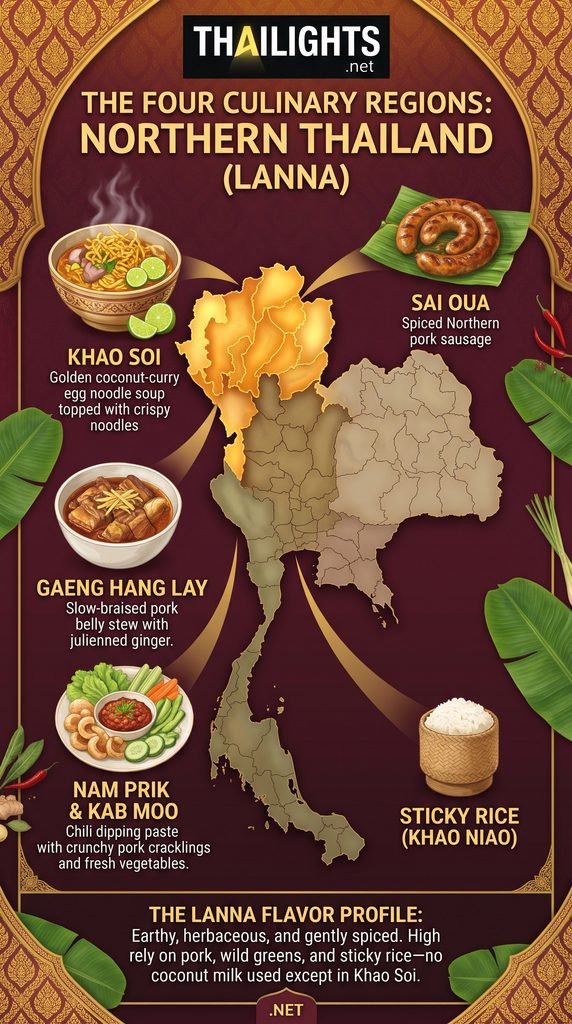
Leg One: The Misty Northern Valleys of Lanna
Our road trip begins along the high ridges and quiet river valleys of the North, centered around cities like Chiang Mai, Chiang Rai, and Mae Hong Son. This region was once the independent Kingdom of Lanna, an ancient realm surrounded by forested peaks and cool winter nights.
The first thing that surprises visitors in the North is the absence of coconut palms. Coconut trees need tropical humidity and warm coastal air to thrive, neither of which you find among the pine-covered hills of the northern highlands. Because fresh coconut milk was historically unavailable, classic northern cooks rarely thickened their stews or balanced their spices with rich coconut cream.
Instead of creamy curries, Northern cooking leans into earthy, bitter, herbaceous, and savory profiles. Dishes feature wild forest herbs, bamboo shoots, bitter greens, and plenty of pork. Cold mountain evenings created a natural appetite for hearty animal fats and slow-simmered comfort meals.
The heart of every Northern meal is sticky rice, known locally as khao niao. Long-grain jasmine rice does not grow well on steep mountain slopes, but glutinous rice flourishes in hillside terraced paddies. Diners compress small clumps of warm, steamed sticky rice between their thumb and fingers, shaping it into an edible vessel to scoop up rustic dipping pastes called nam prik.
Two dips define northern table hospitality: nam prik num and nam prik ong. The first is a smokey, pale-green mash made by charring long green chilies, shallots, and garlic over wood embers before grinding them in a stone mortar. The second, nam prik ong, shows the influence of nearby Shan and Burmese cooking, bringing together minced pork, small tart mountain tomatoes, and fermented soybean cakes into a rich, reddish sauce that tastes like a deeply spiced Thai bolognese. Diners drag crispy pork cracklings, boiled mountain beans, and crisp cucumbers straight through the bowls.
If you wander into an outdoor night market in Chiang Mai, you will smell sai oua sizzling over charcoal long before you see the grill. This is the king of Thai sausages, stuffed with coarsely ground pork belly, kaffir lime leaves, fresh lemongrass, cilantro, and red curry paste. The pork casing snaps crisp when bitten, releasing a wave of citrus aroma and woodsmoke.
When a rich stew is called for, northern kitchens turn to gaeng hang lay, a Burmese-style pork belly stew that reveals ancient caravan routes between Myanmar and India. Simmered until the meat falls apart with the touch of a spoon, gaeng hang lay skips coconut milk entirely. It gains its deep, glossy mahogany sauce from tamarind pulp, pickled garlic bulbs, mountain ginger cut into delicate matchsticks, and dry warming spices like turmeric and dried coriander seeds.
The rare exception to the Northern coconut rule is khao soi, the famous noodle soup found in open-air shops across Chiang Mai. Brought to the region by Muslim traders traveling along ancient trade routes from Yunnan, China, khao soi settles soft egg noodles into an aromatic, golden broth enriched with coconut milk, whole chicken drumsticks or braised beef shank, and dried curry powder. Crowned with a nest of crunchy fried noodles and served with raw shallots, pickled mustard greens, and a fresh lime wedge, it stands as the North’s most beloved cross-cultural masterpiece.
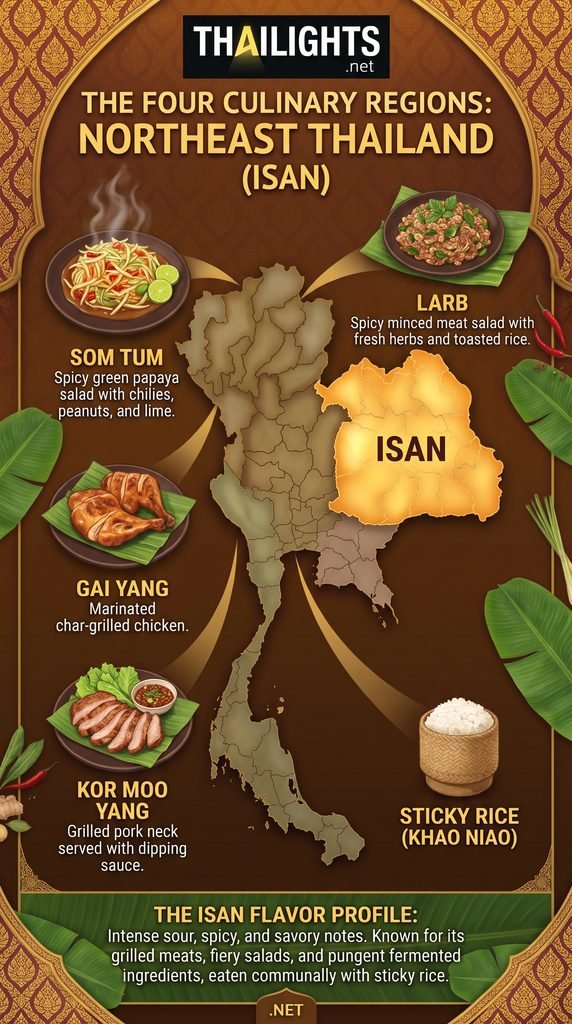
Leg Two: The Sun-Baked Plateau of Isan
Driving eastward past the mountain gaps, the lush green terrain flattens out into the vast, red-dirt expanse of the Khorat Plateau. This is the Northeast, universally known as Isan. Bordered by the mighty Mekong River to the north and east, Isan is an agricultural landscape defined by extremes: scorching dry seasons where dirt roads crack under the sun, followed by torrential monsoon flooding.
Life on the plateau has historically demanded resilience, ingenuity, and a waste-nothing mindset. Because cattle and pigs were valuable working animals, Isan cooks relied on whatever could be gathered, caught, or preserved from the immediate environment, including freshwater fish from muddy canals, field crabs, wild herbs, and insects.
The resulting food culture is bold, punchy, and wildly direct. Isan food does not hide behind sugar or mellow fats. It delivers blistering chili heat, bright sour tamarind and lime juice, char-grilled meats, and the deep, fermented umami of pla ra.
Pla ra is the beating heart of the Isan kitchen. To make it, cooks pack small freshwater fish into clay jars with salt and toasted rice bran, letting the mixture ferment in the tropical heat for anywhere from six months to three years. The resulting liquid and fish paste has an unmistakable funky, earthy punch that functions like liquid gold in regional cooking, adding an intense savory spine to almost every dish.
Foreigners often meet Isan food through som tum, green papaya salad, but what most restaurants outside Thailand serve is the mild, Central-adapted version (som tum thai), made with roasted peanuts, dried shrimp, and plenty of palm sugar. In an authentic Isan home, you will encounter som tum pu pla ra. The cook tosses raw, unripened papaya shreds into a tall wooden mortar with whole garlic cloves, fiery bird’s eye chilies, salted black field crabs, raw lime wedges, and a generous ladle of dark, pungent pla ra. It is unapologetically sour, salty, and spicy, designed to make your mouth water and awaken your senses.
Sticky rice rules Isan just as it does the North, served in woven bamboo baskets called kratip. You pull a ball of warm rice, squeeze it lightly, and use it to tame the heat of larb. While often labeled a salad, larb is an essential protein dish made from hand-minced pork, chicken, beef, or duck flashed quickly in a pan, then tossed with fresh mint, culantro, shallots, dried red chili flakes, fresh lime juice, fish sauce, and the magic ingredient: khao khua.
Khao khua is raw sticky rice roasted in a dry skillet with lemongrass and kaffir lime leaves until deeply golden and fragrant, then pounded into a gritty powder. Sprinkled over larb, it adds a smoky, nutty flavor and a welcome crunch that balances the tender meat and sharp lime juice.
To round out the meal, Isan dining relies heavily on the open fire. Skewers of gai yang (marinated chicken steeped in garlic, coriander roots, and white pepper) and kor moo yang (succulent pork neck grilled until caramelized and sliced thin) balance the fiery salads. The food is communal, casual, and designed to be shared outdoors with friends and cold drinks.
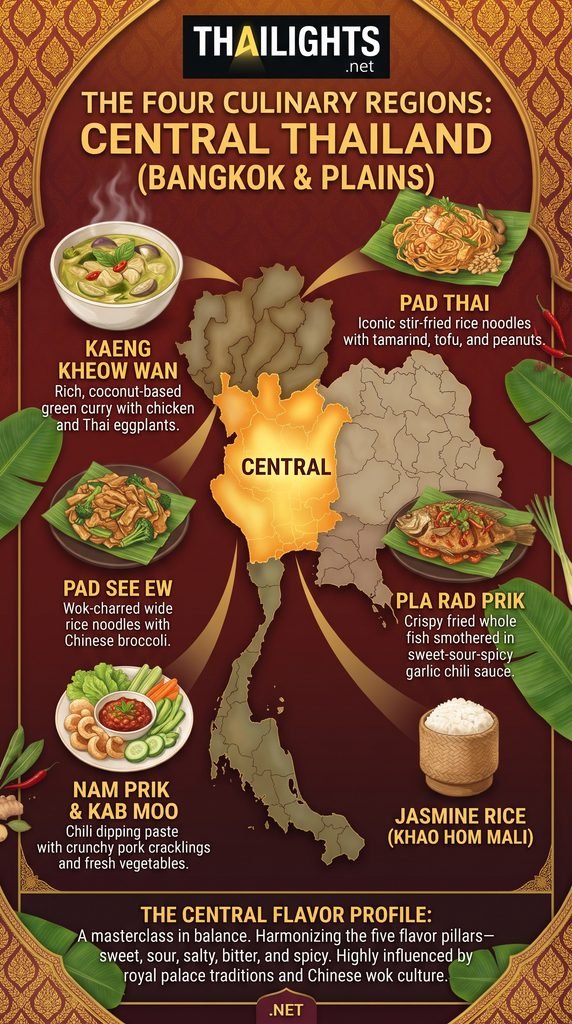
Leg Three: The Fertile Heartland of the Central Plains and Bangkok
Heading southwest, the elevation drops into the low-lying, emerald-green Central Plains, a vast river basin fed by the Chao Phraya River. For centuries, this floodplain has served as the rice bowl of Southeast Asia, crisscrossed by endless canals, rice paddies, floating markets, and fruit orchards heavy with mangoes, guavas, and coconuts.
Central Thai cuisine is the culinary voice most Western diners recognize, but it is far more complex than simple takeout favorites suggest. The Central palate was shaped by two major historical forces: the refined balance of the Royal Siamese Court and centuries of immigration from southern China, particularly Teochew merchants and laborers.
The Royal Court in Ayutthaya and later Bangkok viewed food as high art. Royal cooks were required to create balance, ensuring no single flavor bullied another. A royal dish had to feature a delicate harmony of sweet, sour, salty, bitter, and hot, presented with intricate fruit and vegetable carvings and boneless preparations.
This courtly tradition gave birth to the smooth, rich curries that define the region. In the Central Plains, coconut trees grow in abundance, allowing cooks to press fresh coconut cream daily. This fresh cream is cracked over a gentle flame until the coconut oil separates, creating a shimmering pool where freshly pounded herb pastes are fried until aromatic.
This is where you find gaeng keow wan, the celebrated green curry. Its pale green hue comes not from dried spices, but from fresh green bird’s eye chilies pounded with lemongrass, galangal, kaffir lime peel, cilantro roots, and shrimp paste. Simmered with tender chicken, pea eggplants, and sweet Thai basil, it delivers a rich, herbal warmth that coats the palate.
Central cooking also created tom yum goong, the iconic hot and sour soup. A proper Central tom yum balances rich freshwater river prawns, fragrant crushed lemongrass, cracked galangal, and bruised lime leaves in a clear or evaporated-milk-enriched broth, seasoned right before serving with fresh lime juice, savory fish sauce, and roasted chili paste (nam prik pao).
At the same time, Chinese immigrants transformed the street corners of Bangkok into a wok-fired paradise. They brought flat-bottomed woks, high-heat cooking techniques, soy sauce brewing, and wheat and rice noodles.
Dishes like pad see ew show this heritage clearly: wide, flat rice noodles charred against the scorching steel of a wok with Chinese broccoli, pork, and dark sweet soy sauce. The famous street staple pad krapow—holy basil stir-fried with minced meat and garlic—was born out of this fast, fiery street-cart tradition, always served over warm jasmine rice and crowned with a crispy fried egg (khai dao) featuring lacy, bubbly edges and a molten runny yolk.
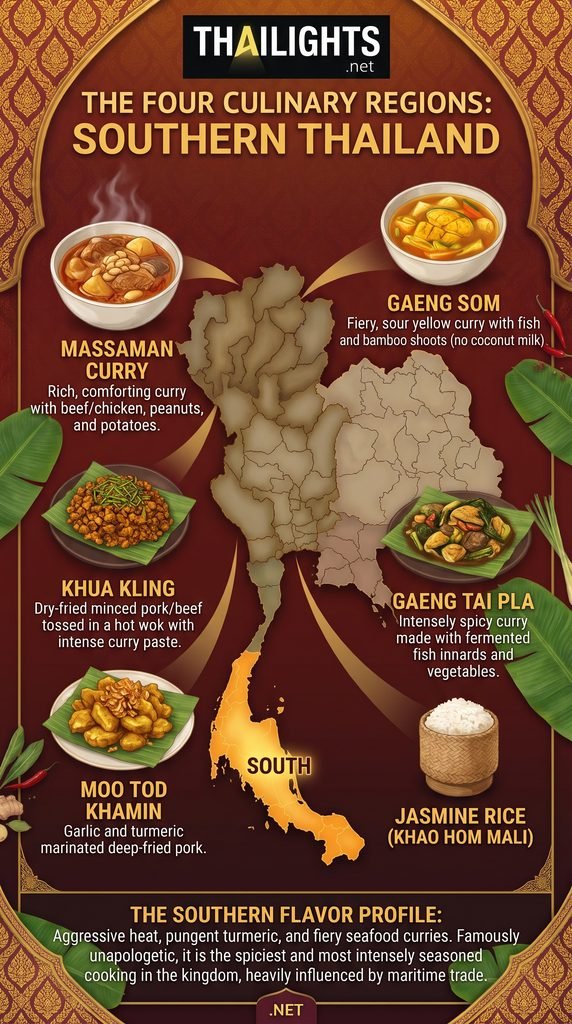
Leg Four: The Spice-Laden Tropical South
Our road trip finishes by traveling down the long, slender southern peninsula. Flanked by the Andaman Sea on the west and the Gulf of Thailand on the east, the South is a land of continuous tropical warmth, sudden rainstorms, rubber plantations, and towering limestone cliffs jutting out of the water.
Southern Thailand has spent hundreds of years acting as a maritime crossroads. Muslim traders from India, Persia, and the Malay Archipelago regularly anchored in southern ports, bringing bags of whole dried spices that were completely absent from northern hill tribes. At the same time, the local waters provided an endless bounty of fresh fish, crab, squid, and prawns.
The result is a cuisine that is unapologetically intense. Southern Thai food is famous for having the highest spice threshold in the kingdom, balanced by salt, sharp acidity, and heavy amounts of fresh turmeric root. Southern cooks use turmeric so generously that cutting boards and pots across the region are stained a bright, cheerful yellow.
The ultimate introduction to southern heat is gaeng som, often called gaeng lueang or southern yellow sour curry. Unlike Central curries, this soup uses zero coconut milk. It is a thin, bright yellow broth made from pounded fresh turmeric, dried red chilies, garlic, shallots, and shrimp paste, simmered with firm sea fish and crunchy green papaya or bamboo shoots. Soured with fresh lime juice and tamarind, gaeng som hits your tongue like a thunderclap: bracingly sour, deeply salty, and searingly hot.
Another iconic regional preparation is khua kling, a dry-fried curry that tests the limits of spice lovers. Minced beef or pork is tossed in a dry wok with an intensely concentrated southern curry paste and mountains of thinly julienned kaffir lime leaves. The meat is stirred continuously over medium heat until every trace of moisture cooks away, leaving each morsel of meat coated in a fiery, aromatic crust. You eat it accompanied by a massive platter of fresh raw vegetables, yardlong beans, and cucumber slices to cool your mouth between bites.
Yet the South also knows how to embrace deep, comforting sweetness and warmth, best seen in massaman curry. Heavily influenced by Persian and Indian Muslim merchants, this slow-simmered beef or chicken stew combines coconut cream with whole dry spices like cardamom, cinnamon, cloves, and star anise, stewed with whole potatoes and roasted peanuts. It is gentle, rich, and fragrant, serving as a reminder that the same region that embraces tongue-scorching heat also created one of the world’s most luxurious comfort stews.
Bringing the Road Trip to Your Table
Looking at Thai cooking through the lens of geography transforms how you order in a restaurant. You no longer have to look at a menu as an endless list of disconnected stir-fries and noodles. Instead, you can spot the fingerprints of the terrain.
When you want something soothing, herbal, and earthy, look toward the North for slow-cooked pork stews, herbaceous sausages, and sticky rice. When you crave high-voltage acidity, fresh herbs, charcoal-grilled meats, and bold funky depth, dive into the Isan section for papaya salads and minced-meat larb.
When you want the creamy, fragrant balance of sweet coconut milk and wok-charred noodles, stay in the Central Plains. And when you are ready for serious chili heat, bright yellow turmeric, and punchy coastal seafood, let the Southern peninsula take the wheel.
By treating a Thai menu like a map rather than an encyclopedia, you step past the safe tourist options and experience the country the way locals do: one distinct, unforgettable region at a time.