

Mickey Rooney taped his eyelids back, rammed buck-teeth into his gums, and kicked over trash cans in 1961’s Breakfast at Tiffany’s. Audiences howled. But this depiction of the Asian male wasn’t just cheap theater laughs, it was literally an Asian exorcism. For nearly a century, the West had harbored a bizarre, twitchy panic over the Asian man, and Mr. Yunioshi was the tranquilizer: proof that this foreigner was a squeaking, slapstick imp who could never steal your girl, let alone run a boardroom.
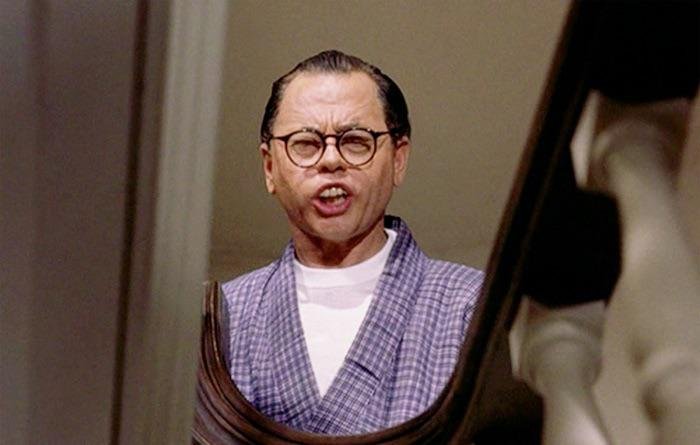
The deal Hollywood struck with Asian masculinity was simple: surrender your libido at the border. You could lurk in opium dens like Fu Manchu, pad around the Ponderosa kitchen like Hop Sing, or crack collarbones like Bruce Lee. But bed the lead? Forget it. When Jet Li stepped into Romeo Must Die in 2000, American test audiences recoiled at the mere suggestion of him kissing Aaliyah. The studio scrambled, snipped the romance, and left him with a stiff, sorrowful hug. A literal Romeo, legally forbidden to get the girl.
Now step off the Skytrain at Siam Paragon.
Towering LED walls bathe the humid Bangkok night in ten-story portraits of Mile Phakphum and Apo Nattawin, draped in razor-sharp Dior, looking devastatingly untouchable. Nearby, Bright Vachirawit smolders for Burberry. Tens of thousands of screaming fans pack arenas from Mexico City to Manila just to watch these men lock eyes, sip from shared boba straws, and trade soft, whispered promises.
The wrecking ball that shattered a century of Western racial castration didn’t emerge from an indie studio in Tribeca or a Sundance incubator. It tumbled out of Thai evening television, specifically, the frenzied, glossy, tear-drenched universe of Boys’ Love, or Series Y.
The historical muzzle they ripped off had deep roots. Back in the 1860s, Chinese laborers chipped through Sierra Nevada granite, built railroads, and survived on pure grit. White Americans panicked. In response, they ran Asian laborers out of mines and lumber mills at gunpoint, forcing them into domestic corners nobody else wanted: hand laundries, kitchens, tailoring. In Victorian America, touching silk and boiling linen was women’s work. Society weaponized that labor. To cap it off, laws like the Page Act of 1875 and the Chinese Exclusion Act choked off Asian female migration, barring these men from family life and criminalizing romance across the color line. The state essentially legislated them into monkhood.
Fast forward through decades of yellowface, martial arts retribution machines, and late-stage Hollywood diversity efforts that mostly consisted of handing Asian actors kettlebells, dropping their voices an octave, and ordering them to act like Vin Diesel. Assimilate, bulk up, don’t feel.
Bangkok bypassed the Western casting gauntlet entirely.
Thai producers didn’t bother asking for validation from the West. They simply leaned into the wild, uninhibited mechanics of local lakorns, soap operas drunk on family vendettas, heightened stares, slap-and-kiss dynamics, and sheer melodrama, and crossed them with online pulp novels borrowed from Japanese yaoi.
Early breakouts like Love Sick (2014) and SOTUS (2016) set the stage inside university engineering quads. Then 2020 hit. The world locked down, trapped in sweatpants and doomscrolling, and 2gether: The Series landed like an electric shock. Bright Vachirawit and Win Metawin strummed guitars, bumped shoulders, and offered pure dopamine.
Two years later, KinnPorsche blew the pastel doors off the hinges. Directed with midnight noir flair, it dropped Mile and Apo into silk shirts, underground mob compounds, and raw, sweat-slicked eroticism. It wasn’t sanitizing gay love for prime time, nor was it retreating into clownish sidekicks. The camera lingered on trembling fingers, the crook of a neck, the heavy heat between two men holding guns. For the first time on a global commercial scale, the Asian male was unapologetically, incandescently desirable.
The style here wasn’t borrowed from Western machismo. Thai celebrity culture traded in a luminous, unabashed “soft masculinity.” These actors could throw a roundhouse kick on screen, then walk a red carpet in pearl chokers, lilac organza, and dewy makeup. They wept openly with fans during arena tours, held hands without twitchy iron-jaw posturing, and exposed their neuroses without losing an ounce of swagger.
Naturally, the legacy fashion houses took notice. Dior, Prada, and Tiffany stopped looking exclusively to Hollywood’s brooding leading men and hitched their wagons to Bangkok.
Still, the fantasy has friction.
The engine driving Series Y is the “ship,” an exhausting industrial apparatus where actors are locked into hyper-lucrative pairs (MileApo, ZeeNuNew, BillkinPP). Their chemistry is milked across commercial sponsorships, live meet-and-greets, and curated Instagram banter, blurring the curtain between genuine affection and corporate quarterly goals. Escaping the eunuch cage only to be repackaged as a live-action, squeaky-clean doll for screaming crowds brings its own kind of claustrophobia.
Then there is the mirror Thailand holds up to itself. Scan the billboard skyline: the faces are almost uniformly pale, chiseled, and reflective of wealthy Sino-Thai lineages. The darker-skinned, working-class men from Isan or the southern provinces—who embody so much of the country’s ethnic fabric, rarely get cast as the wealthy heir in a velvet tuxedo.
Yet for all its commercial artifice and colorist blind spots, something profound shifted. Thailand’s parliament formalized what the country’s pop exports had long normalized, passing marriage equality to become the first nation in Southeast Asia to do so. Culture didn’t just reflect the change; it dragged the baseline along with it.
The old ghost of Mickey Rooney’s Mr. Yunioshi, grotesque, neutered, shuffling in the background, has finally run out of runway. In his place stands an Asian man on a billboard thirty feet high, bathed in neon, entirely unbothered, daring you to look away.