

For decades, the domestic television landscape in Thailand was governed by an unspoken social contract: protect the institutions at all costs.
If you turned on an evening broadcast, the boundaries were drawn in stone. The dramas (lakorns) played out inside sprawling, sterile mansions where villains shrieked and over exaggerated their stares like pantomime caricatures, the ever virtuous heroines suffered with folded hands, and every social infraction was neatly smoothed over before the midnight national anthem. Thai horror was allowed into theaters, but only if it behaved: keep the terrors confined to village cemeteries, let a barefoot monk chant protective Pali verses in the final reel, and reassure the audience that the moral universe was running on a reliable karmic balance sheet.
Then came Nanno, stepping off a city bus in a crisp pleated school uniform, tilting her head with a dead-eyed grin, and systematically dismantling every polite lie in Thai civil society.
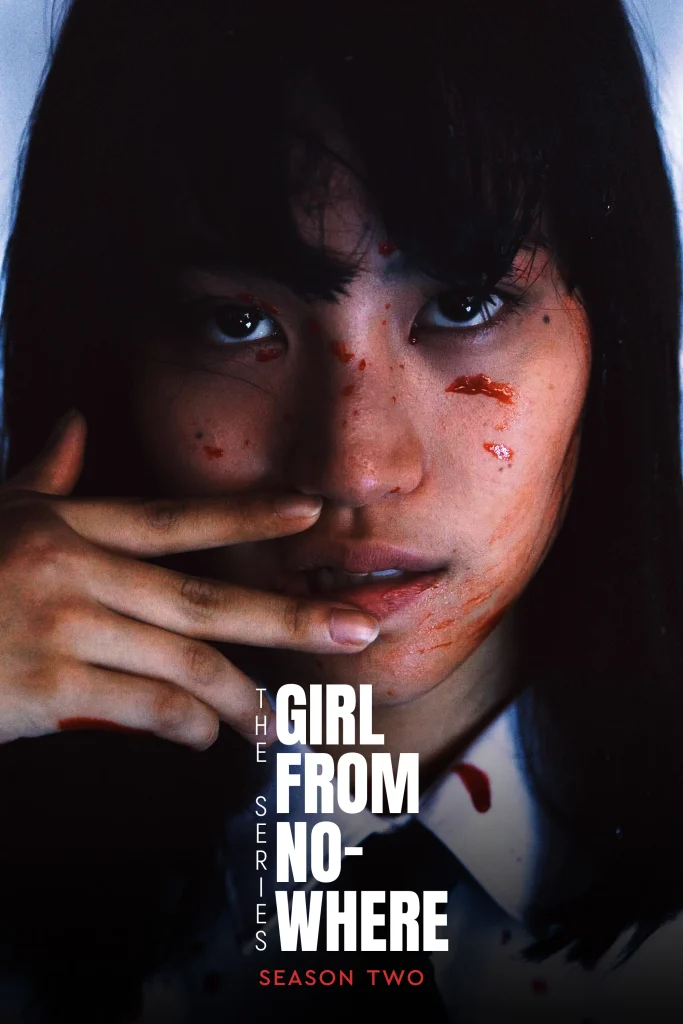
When Girl from Nowhere (Dek Mai) landed on GMM 25 in 2018, it rattled Thai society and took an axe to the foundational mythology of Thai social order.
The spark came out of SOUR Bangkok, an independent creative shop run by Damisa Ongsiriwattana that had spent years studying the hypocrisies of modern consumer culture. While legacy networks were busy churning out safe campus romances, SOUR’s writers were combing through the ugly, suppressed police blotters of the Bangkok morning news: privileged high-school boys who killed pedestrians in luxury sports cars and walked away without charges, school administrators sweeping statutory rape under the rug to protect elite accreditation and senior students brutalizing underclassmen in sadistic, state-sanctioned hazing rituals (SOTUS).
The classroom in Thailand was a pressure cooker designed to enforce obedience, class hierarchy, and deference to authority (kreng jai). To blow that world open, SOUR didn’t craft a pious social-crusader or an investigative crusader with a clipboard. They engineered an immortal, unholy karmic trickster.
Nanno arrived not to be the savior of victims, but rather to dangle the proverbial apple. She watched human cowardice, vanity, and sadism fester inside the faculty lounge, nudging the dominoes just enough to let the rot consume itself from within.
By hiring a murderer’s row of independent film and commercial auteurs, stylists like Sitisiri Mongkolsiri, Pairach Khumwan, and Komgrit Triwimol, the production dodged the cheap, soap-opera lighting that plagued domestic television. Every episode was constructed like a standalone, razor-sharp short film, swinging violently from monochromatic arthouse tragedy to candy-colored, blood-soaked satire. The engine that turned the experiment into a global psychological firestorm was Chicha “Kitty” Amatayakul.
Taking visual cues from Junji Ito’s legendary manga temptress Tomie, Kitty injected the character with a distinctly Thai brand of malicious swagger. With her razor-sharp blunt bangs, cigarette-stained cynicism, and that high-pitched, mocking cackle that cut through pious school assemblies like a rusted scalpel, she refused to make Nanno likable. She wasn’t a hero, nor an anti-hero, she was a living, breathing karmic detonation. She moved through scenes with an unblinking, serpentine stillness, exposing the reality that the real monsters of Southeast Asia don’t lurk in temple basements or jungle trees. They sit at the principal’s mahogany desk, wearing gold signet rings, smiling politely while destroying lives to protect na ta, the holy preservation of social face.
When Netflix acquired the international rights and subsequently bankrolled Season 2 as a flagship global original in 2021, algorithms across Latin America, Southeast Asia, and Europe were blindsided by the show’s venom.
The introduction of Chanya McClory as Yuri sharpened the blade. Where Nanno was a cosmic observer letting sinners dig their own graves with patient irony, Yuri was a vengeful, red-ribboned revolutionary who wanted blood on the concrete immediately. The collision between the two elevated the series from an episodic horror-revenge showcase into a furious philosophical debate over the morality of retribution.
By the time the universe expanded into Girl from Nowhere: The Reset, the property faced the classic creative curse: how do you keep the fire burning without turning an iconic figure into a hollow waxwork?
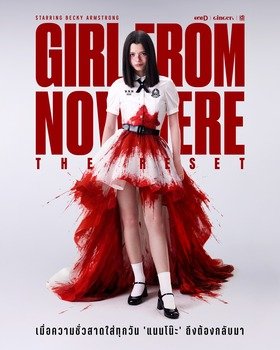
Instead of forcing a tired continuation of the original arc, the creators pulled off an audacious generational pivot by casting Rebecca Patricia Armstrong. Fresh off the cross-border explosion of her Girls’ Love projects, Becky stepped into the pleated uniform and remade Nanno for a fractured digital landscape. Where Kitty was a raw, primal trickster emerging from urban folk nightmares, Armstrong brought an icy, cosmopolitan detachment that mirrored a newer, colder variety of dread: algorithmic validation, digital mob justice, deepfake surveillance, and corporate-sponsored morality. Paired with rising talents like Prudtichai Ruayfupant (“Sam”), The Reset scorched across Netflix’s global Top 10 in over sixty territories, confirming that the franchise’s mythology didn’t belong to a single actress, it was a durable, elastic framework for dissecting modern systemic cruelty.
Before Nanno laughed in the dark, the world’s vision of Thai screen entertainment was split into two neat, comfortable files: cinephiles holed up with the meditative arthouse cinema of Apichatpong Weerasethakul, while casual audiences binged pastel-tinted campus romances and high-society melodramas.
Girl from Nowhere tore a third door straight through the wall. It proved that Thai creators could make vicious, unapologetically localized genre television that travels across borders without softening its teeth, reminding audiences everywhere that the most terrifying thing on the planet is a system that demands your silence.
