

If you wanted to cook a bowl of tom yum in Southern California in 1968, you basically had to commit agricultural contraband.
Fresh kaffir lime leaves didn’t exist in supermarket bins; they arrived dried out and flat inside greeting card envelopes mailed from Bangkok. Lemongrass was a rumor. Holy basil (krapao) was cultivated like contraband under closet heat lamps, and cooks whispered about whether flat-leaf Italian parsley had enough peppery bite to trick dinner guests into thinking it was wild coriander root.
The entire landscape of how Americans eat Asian food changed because a Hainanese-Thai immigrant named Pramorte “Pat” Tilakamonkul looked around Los Angeles and realized his community was starving for home.
At the center of that culinary revolution was a kid standing on an overturned plastic milk crate behind a butcher counter: Jet Tila.
Before he became a fixture on Food Network screens, a bestselling cookbook author, and a culinary ambassador appointed by the Royal Thai Government, Jet was born Jet Tilakamonkul on February 6, 1975. He wasn’t raised in a culinary academy like many celebrity chefs, he grew up on cracked linoleum, inhaling the scent of roasted shrimp paste, bleeding out poultry, and watching his parents build the physical supply line that made Thai Town possible.
The 600-Square-Foot Miracle on Melrose
Pat and Marasri Tilakamonkul didn’t land in California with venture capital. Arriving separately in 1966, Pat parked cars outside Grauman’s Chinese Theatre and scrubbed dishes in diner basements. Back in Bangkok, he had grown up inside a noisy family shophouse running Hainanese noodles and dark roast coffee. He understood how food created community, and in 1972, he took a gamble on a cramped 600-square-foot storefront on Melrose Avenue in East Hollywood.
They named it Bangkok Market. It was the very first Thai and Southeast Asian grocery store in the United States.
Opening a grocery store is one thing; keeping it stocked when trade routes are nonexistent is an entirely different war. Pat wasn’t an entrepreneur who was happy to sit behind a counter. He knew he had to build out his supply chain and bought a truck, drove up to the Central Valley, and sat down with farmers in Fresno. Working with pioneers like S.S.K. Produce, he handed over Thai seed packets and showed California growers that the Central Valley’s blistering summer heat could mimic the climate of the central plains of Thailand.
When winter frost threatened production, Pat pushed south across the border into Mexico, establishing direct trade links to ensure a year-round harvest of green papayas, yardlong beans, and jackfruit. Long before global shipping giants streamlined supply chains, Pat Tilakamonkul was chartering air-cargo pallets out of Don Mueang straight into LAX, filling luggage holds with true fish sauce, curry pastes, and jasmine rice.
Bangkok Market became the undisputed nerve center of Thai Los Angeles. As culinary historian Dr. Mark Padoongpatt documented, it was where newcomers cashed their paychecks, found shared apartments, read newly printed Thai-language gazettes, and pooled cash to fund the construction of Wat Thai of Los Angeles in North Hollywood. In 1978, the family expanded to launch Royal Thai Cuisine on Pico Boulevard near 20th Century Fox, introducing studio execs and neighborhood regulars to their first tastes of real pad Thai and sizzling chicken satay.
The Milk-Crate Apprenticeship
While other 1980s kids in East Hollywood were riding BMX bikes or watching Saturday morning cartoons, Jet was putting in eight-hour shifts at his family’s market.
He was eight years old, standing on overturned milk crates so his chin cleared the meat counter. He butchered whole chickens, sliced pork bellies, and hauled 50-pound burlap sacks of Three Ladies jasmine rice until his forearms burned. He learned Thai cooking the ancient way through raw repetition, heat, and sensory memory. His grandmother and father didn’t teach him from measuring spoons, they taught him to listen to the hiss of garlic hitting a blistering wok, to gauge the salinity of fish sauce by the sheen on the surface, and to respect the delicate tightrope walk of the five essential flavors: sweet, sour, salty, bitter, and spicy.
Jet knew ancestral instinct could take him far, but he wanted the technical grammar to back it up. He enrolled in the California School of Culinary Arts in Pasadena (Le Cordon Bleu) and finished courses at the French Culinary Institute in New York City.
Suddenly, he possessed an almost unfair bilingual fluency in the kitchen. He could debate the precision of a classical French reduction sauce using the brigade system, then turn around, fire up a 100,000-BTU jet-burner wok, and toss noodles with pure, effortless street-side muscle memory.
The Jonathan Gold Discovery and the Vegas Strip
Jet’s breakout didn’t start on a television soundstage. It started in his living room and in the back aisles of Bangkok Market, where he hosted intimate, guerrilla cooking classes. There, he broke down the geography of the ingredients, why northern curries skip coconut milk, how fermented fish paste (pla ra) gives northeastern salads their deep funk, and why balancing lime juice and palm sugar requires intuition rather than a measuring cup.
Those backyard sessions caught the ear of legendary Los Angeles Times critic Jonathan Gold. Gold was mesmerized. He wrote glowing pieces celebrating Jet’s encyclopedic command of Southeast Asian foodways, joining Jet on walking tours through the newly minted Thai Town, an official neighborhood designation on Hollywood Boulevard established in 1999 that the Tila family’s commercial roots had made possible.
From there, the culinary world came knocking. Casino mogul Steve Wynn brought Jet to Las Vegas to open Wazuzu at the Wynn Encore, where his drunken noodles became a legendary late-night sanctuary for high-rollers and off-duty chefs alike. He opened The Charleston and Stir Market in Los Angeles, partnered with Dallas-based Pakpao Thai to bring authentic khao soi to Texas, and launched Dragon Tiger Noodle Co. in Nevada.
When he took on the role of Vice President of Culinary for Pei Wei Asian Kitchen, overseeing menus across more than 160 locations, he proved that mass-market Asian dining didn’t have to mean watered-down sauces and canned vegetables—he brought fresh aromatics, wok char, and technical integrity to commercial scale.
From Cutthroat Kitchen to Cultural Statesman
Turn on Food Network over the last fifteen years, and Jet Tila is everywhere.
He became a household name not by playing an over-the-top, larger-than-life caricatured TV personality, but by being the calm, unflappable grown-up in the room. On Cutthroat Kitchen, his dry deadpan reactions and encyclopedic culinary breakdowns kept the show anchored when chefs were trying to cook with aluminum foil and blowtorches. He won the $20,000 championship on Guy’s Grocery Games, survived the brutal gauntlet of Iron Chef America (later returning as the floor reporter), and battled his way to the deepest rounds of Tournament of Champions.
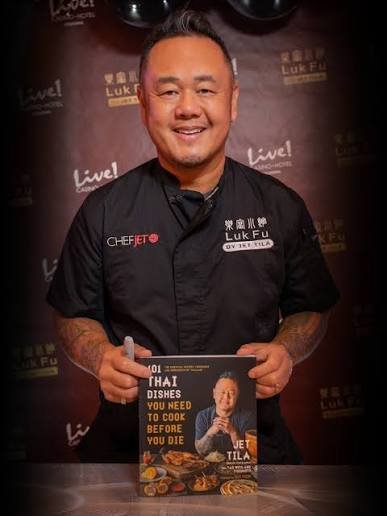
Through Emmy-nominated shows like Ready Jet Cook, he demystified Asian cooking for millions of nervous home cooks, proving that you don’t need a professional restaurant kitchen to make a phenomenal pad see ew. His cookbooks, including 101 Asian Dishes You Need to Cook Before You Die (named a top cookbook of the year by the Los Angeles Times) and 101 Thai Dishes, did the same work in print, earning him a prestigious James Beard Foundation Award nomination.
Jet turned food advocacy into high-energy community celebrations, organizing volunteers to shatter Guinness World Records for the world’s largest stir-fry (weighing in at an absurd 4,010 pounds), a 6,500-pound seafood stew, and a 15,291-pound fruit salad.
In 2013, the Royal Thai Consulate-General in Los Angeles gave that work official recognition, naming Chef Jet Tila the very first Culinary Ambassador of Thai Cuisine. It was a historic moment: the child of undocumented market pioneers being formally recognized by the sovereign Thai government as the premier voice of its culinary heritage abroad.
The Legacy of the Cash Register
When Bangkok Market finally closed its doors in 2019 upon Pat and Marasri’s well-earned retirement after nearly fifty continuous years of operation, it felt like the quiet sunset of an era.
The physical storefront was gone, but the seeds the Tila family planted in 1972 had already grown into an unbreakable forest.
Every time an American home cook casually grabs a bottle of fish sauce at a neighborhood grocery store, every time a family sits down at a strip-mall Thai restaurant in Ohio, and every time an Asian chef commands the main stage on national television, they are walking through a door that Pat and Marasri pushed open.
Jet Tila spent his childhood carrying bags of rice through the back alleys of Hollywood. Today, he carries the culinary legacy of an entire nation—proof that with a sharp knife, a hot wok, and an enduring respect for where you came from, an immigrant story can change how the entire world eats.
