

For a solid ten years, trying to launch a Thai girl group was basically an expensive way to lose money.
The domestic charts belonged to indie rock bands, acoustic balladeers, and rural luk thung titans who could sell out temple fairs without breaking a sweat. When Thai kids wanted glossy choreography, synchronized razor-sharp dancing, and high-budget visual concepts, they looked straight to Seoul. The few local idol projects that crawled into the daylight felt like underfunded counterfeits, stiff, painfully polite, and trying so hard to copy Blackpink or TWICE that they forgot to sound like anything you’d actually hear coming out of a Bangkok motorbike speaker.
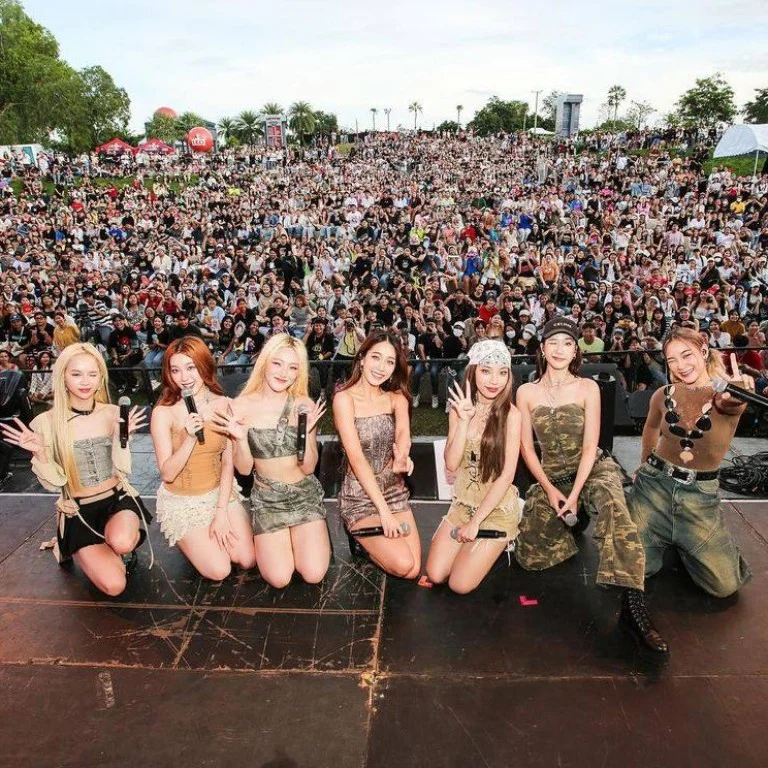
Then December 2020 rolled around. The world was trapped in pandemic lockdown, industry morale was in the gutter, and XOXO Entertainment dropped seven girls onto a soundstage in oversized streetwear, chewing gum and hitting beat drops with bad-attitude swagger.
They called themselves 4EVE. And instead of apologizing for not being Korean, they hijacked Thai pop culture and made the home crowd fall head-over-heels for their own music again.
The Survival Gauntlet That Actually Worked
4EVE didn’t come out of a shadowy basement training room, they fought their way through Workpoint’s Girl Group Star.
Most reality competition groups dissolve into awkward political compromises where nobody’s style matches. But when the dust settled on the finale, the resulting septet clicked like a puzzle:
- Mind (Atitaya Tribudarak): The eldest and the anchor. A theater kid and seasoned actress who knows exactly how to sell a lyric with her eyes before she even opens her mouth.
- Jorin (Khumpiraphan): Pure low-end menace. With an effortlessly cool, tomboyish sneer and a smoky, gravelly alto voice, she became an instant magnet for anyone tired of cookie-cutter bubblegum pop.
- Taaom (Benyapa Unjit): The group’s high-fashion eccentric. Tall, razor-cheekboned, and runway-trained, she stares down a camera lens like she’s about to bill it for consulting hours.
- Hannah (Rosenbloom): The Laotian secret weapon. Already a recognized star in Vientiane before crossing the Mekong, she brought cross-border star wattage and an airy, crystalline vocal register that floats over hard beats.
- Fai (Nattaya Buttachote): The b-girl engine. She isn’t doing polite, learned-in-a-studio idol handography; she hits hip-hop routines with bone-cracking power that makes casual viewers stop scrolling mid-TikTok.
- Punch (Tipnan Nilsiam): High-octane social energy incarnate. A former digital creator who understood audience attention spans before she ever touched a studio mic, radiating pure Gen-Z charisma.
- Aheye (Korranid Laosubinprasoet): The baby of the pack, but technically the veteran. She spent her childhood belting theater standards and working production sets, providing the dizzying high notes and vocal insurance policy that keeps their live sets from crashing.
The “Test Me” Shockwave
Their debut single, “Oohlala!”, got people’s attention, but “Test Me” (Wat Fee) was the cultural hand grenade.
Produced alongside hip-hop heavyweights like URBOYTJ, the track stopped trying to emulate Seoul’s tempo and leaned straight into modern Bangkok rhythm. It had space. It had swagger. The cadence had that sly, playful Thai flirtatiousness bouncing between casual conversational talk-singing and an irresistible, low-slung hook that sounded just as natural blaring out of a customized pickup truck as it did on wireless earbuds. It was unapologetically T-Pop. The song exploded across streaming charts and dance challenges, proving a point that record executives had been terrified to test: you didn’t need to sing in phonetically strained English or mimic Korean song structures to make a modern masterpiece.
Building the Runway While Flying the Plane
Before 4EVE, local labels treated idol pop like a hobby. XOXO Entertainment treated it like infrastructure.
They pumped serious money into cinematic music videos, hired top-tier regional stylists, and threw their weight behind the weekly T-Pop Stage Show, giving domestic acts a polished, televised performance arena that finally rivaled South Korea’s music bank broadcasts.
The domino effect was instantaneous. Suddenly, investors realized that Thai fans, long considered a captive audience for foreign imports, would mobilize an army of streaming hours and stadium sellouts if you gave them local idols with real grit and top-tier packaging. In their wake came the floodgates: boy-group juggernauts like ATLAS and PROXIE, girl-group dynamos like PiXXiE, and an entire generation of trainees who realized they didn’t have to move to Seoul to become superstars.
The Throne Isn’t Up for Grabs
Four years on, 4EVE isn’t just surviving the notoriously brutal pop-group lifecycle; they’re running laps around it. They bounce effortlessly from gritty club anthems like “Jackpot” to lush, tear-stained vocal ballads, fronting arena concerts and plastering high-rise transit billboards from Siam to Silom.
The old argument that Thai pop was always ten steps behind the rest of the world ended the day these seven women took the stage. They didn’t reclaim the throne by playing somebody else’s game. They simply wrote a whole new set of rules in their own language.
Fast Facts for New Fans
- What does “4EVE” stand for? It’s an internet-age spin on “Forever”—a nod to staying power in an industry notorious for chewing up girl groups and spitting them out in eighteen months.
- What are their fans called? For Aye. It’s a wordplay on “For You” and “Forever,” though if you’re on Thai social media, you’ll just see them moving like an organized union every time voting season opens.
- Where do I start listening? Fire up “Test Me” (Wat Fee) to see why the entire country lost its mind, then queue up “Jackpot” to watch Fai and the dance line demolish the floor.